MCQ
${d \over {dx}}[{e^{ax}}\cos (bx + c)]=$
  • ${e^{ax}}[a\cos (bx + c) - b\sin (bx + c)]$
  • B
    ${e^{ax}}[a\sin (bx + c) - b\cos (bx + c)]$
  • C
    ${e^{ax}}[\cos (bx + c) - \sin (bx + c)]$
  • D
    None of these

Answer

Correct option: A.
${e^{ax}}[a\cos (bx + c) - b\sin (bx + c)]$
a
(a) $\frac{d}{{dx}}[{e^{ax}}\cos (bx + c)]$=$\frac{{dx}}{{dt}} = - 2\sin t + 2\sin 2t$

=${e^{ax}}[a\cos (bx + c) - b\sin (bx + c)]$.

Need a full question paper?

Generate a complete, print-ready paper with questions like this in minutes — across 16+ boards, with answer keys.
Start Generating Free

Similar questions

Let the system of linear equations $4 x+\lambda y+2 z=0$ ;  $2 x-y+z=0$ ;  $\mu x +2 y +3 z =0, \lambda, \mu \in R$ has a non-trivial solution. Then which of the following is true?
If the domain of the function $f(x)=\sin ^{-1}\left(\frac{x-1}{2 x+3}\right)$ is $R-(\alpha, \beta)$ then $12 \alpha \beta$ is equal to :
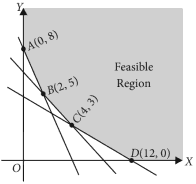
Feasible region for an L.P.P. is shown shaded in the following figure. Minimum of $Z=5 x+3 y$ occurs at the point point
Image
$\int\frac{\text{x}^9}{(4\text{x}^2+1)^6}\text{dx}$  is equal to:
  1. $\frac{1}{5\text{x}}\Big(4+\frac{1}{\text{x}^2}\Big)^{-5}+\text{c}$
  2. $\frac{1}{5}\Big(4+\frac{1}{\text{x}^2}\Big)^{-5}+\text{c}$
  3. $\frac{1}{10\text{x}}\Big(\frac{1}{\text{x}}+4\Big)^{-5}+\text{c}$
  4. $\frac{1}{10\text{x}}\Big(\frac{1}{\text{x}^2}+4\Big)^{-5}+\text{c}$
If f: R → R be given by $f(\text{x})=(3-\text{x}^3)^{\frac{1}{3}},$ then fof(x) is:
  1. $\text{x}^{\frac{1}{3}}$
  2. x3
  3. x
  4. (3 - x3).
If $I_{n+1}$ = $\int\limits_0^1 {\frac{{{x^{n + 1}} - 1}}{{x + 1}}dx} $ then the value of $I_{10} + I_{11} + 2log2$ is-
Let $\vec a = \hat i + \hat j + \hat k,\,\,\,\vec c = \hat j - \hat k$ and a vector $\vec b$ be such that $\vec a \times \vec b = \,\vec c$ and $\vec a\, \cdot \,\vec b = \,3.$ Then $\left| {\vec b} \right|$ equals?
If the direction ratios of a line are $1, - 3,\,2$, then the direction cosines of the line are
For the given half-cylinder of volume $V$, the total surface area $S$ is minimum, when
Let $f : R \rightarrow R$ and $g : R \rightarrow R$ be two functions defined by $f(x)=\log _{e}\left(x^{2}+1\right)-e^{-x}+1$ and $g(x)=\frac{1-2 e^{2 x}}{e^{x}}$. Then, for which of the following range of $\alpha$, the inequality $f\left(g\left(\frac{(\alpha-1)^{2}}{3}\right)\right)>f\left(g\left(\alpha-\frac{5}{3}\right)\right)$ holds?