MCQ
${d \over {dx}}\left( {{{{e^x}} \over {1 + {x^2}}}} \right) = $
  • A
    ${{{e^x}(1 + x)} \over {{{(1 + {x^2})}^2}}}$
  • ${{{e^x}{{(1 - x)}^2}} \over {{{(1 + {x^2})}^2}}}$
  • C
    ${{{e^x}{{(1 + x)}^2}} \over {(1 + {x^2})}}$
  • D
    ${{{e^x}{{(1 - x)}^2}} \over {(1 + {x^2})}}$
Answer

Correct option: B.
${{{e^x}{{(1 - x)}^2}} \over {{{(1 + {x^2})}^2}}}$
b
(b) $\frac{d}{{dx}}\left( {\frac{{{e^x}}}{{1 + {x^2}}}} \right) = \frac{{(1 + {x^2}){e^x} - {e^x}(2x)}}{{{{(1 + {x^2})}^2}}} = \frac{{{e^x}{{(1 - x)}^2}}}{{{{(1 + {x^2})}^2}}}$

Need a full question paper?

Generate a complete, print-ready paper with questions like this in minutes — across 16+ boards, with answer keys.

Start Generating Free

Similar questions

Let $A$ be a $3 \times 3$ matrix of non-negative real elements such that $A\left[\begin{array}{l}1 \\ 1 \\ 1\end{array}\right]=3\left[\begin{array}{l}1 \\ 1 \\ 1\end{array}\right]$. Then the maximum value of $\operatorname{det}(\mathrm{A})$ is........................
If $\text{y}=\text{x}^{\text{n}-1}\log\text{x}$ $\text{x}^2\text{y}_2+(3-2\text{n})\text{xy}_1$ is equals to:
  1. -(n - 1)2y
  2. (n - 1)2y
  3. -n2y
  4. n2y
The distance of the point $P (4,6,-2)$ from the line passing through the point $(-3,2,3)$ and parallel to a line with direction ratios $3,3,-1$ is equal to :
$\int {(\sqrt {\tan x}  + \sqrt {\cot x} )} $ is equal to-
The value of the determinant $\begin{vmatrix}\text{a}-\text{b}&\text{b}+\text{c}&\text{c}\\\text{b}-\text{c}&\text{c}+\text{b}&\text{b}\\\text{c}+\text{a}&\text{a}+\text{b}&\text{c}\end{vmatrix}$ is:
  1. a3 + b3 + c3
  2. 3bc
  3. a3 + b3 + c3 - 3abc
  4. None of these
The slope of normal at any point $(x, y), x > 0, y > 0$ on the curve $y=y(x)$  is given by $\frac{x^{2}}{x y-x^{2} y^{2}-1}$ If the curve passes through the point $(1,1)$, then e. $y(e)$ is equal to
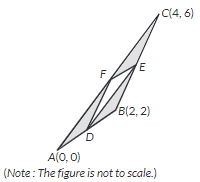
The points $D, E$ and $F$ are the mid-points of $A B, B C$ and $C A$ respectively.
Image
What is the area of the shaded region?
If P(A) = 0.4, P(B) = 0.8 and P(B|A) = 0.6 then $\text{P}(\text{A}\cup\text{B})=$
  1. 0.24
  2. 0.3
  3. 0.48
  4. 0.96
If the set A contains 7 elements and the set B contains 10 elements, then the number one-one functions from A to B is:
  1. $^{10}\text{C}_7$
  2. $^{10}\text{C}_7\times7!$
  3. $7^{10}$
  4. $10^7$
Objective of LPP is: