MCQ
${d \over {dx}}\left[ {\log \sqrt {{{1 - \cos x} \over {1 + \cos x}}} } \right] = $
  • A
    $\sec x$
  • $cosec\,x$
  • C
    $cosec{x \over 2}$
  • D
    $\sec {x \over 2}$

Answer

Correct option: B.
$cosec\,x$
b
(b) $\frac{d}{{dx}}\left[ {\log \sqrt {\frac{{1 - \cos x}}{{1 + \cos x}}} } \right] = \frac{d}{{dx}}\left[ {\log \left( {\tan \frac{x}{2}} \right)} \right] = {\rm{cosec}}\,x$.

Need a full question paper?

Generate a complete, print-ready paper with questions like this in minutes — across 16+ boards, with answer keys.
Start Generating Free

Similar questions

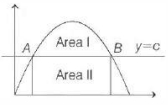
The figure shows a portion of the graph $y=2 x-4 x^3$.The line $y=c$ is such that the areas of the regions marked $I$ and $II$ are equal. If $a, b$ are the $x$-coordinates of $A, B$ respectively, then $a+b$ equals
On which of the following intervals is the function $f$ given by $f(x)=x^{100}+\sin x-1$ decreasing $?$
Consider the following statements:
  1. $\tan^{-1} 1+ \tan^{-1} (0.5) = \dfrac {\pi}2$
  2. $\sin^{-1}{\cfrac{1}{3} }+ \cos^{-1}{\cfrac{1}{3}} =\cfrac{\pi}{2}$
Which of the above statements is/are correct ?
  1. 1 only
  2. 2 only
  3. Both 1 and 2
  4. Neither 1 nor 2
The minimum distance between a point on the curve $y=e^x$ and a point on the curve $y=\log _e x$ is
Let $A = \left[ {\begin{array}{*{20}{c}}
p&{13}\\
{ - 13}&p
\end{array}} \right]$ and $B = \left[ {\begin{array}{*{20}{c}}
{4q}&{85}\\
{ - 2}&1
\end{array}} \right]$  where  $p,q \in N$. It is given that $\left| A \right| = \left| B \right|$ and  $p,q \in[1,1000]$. Then total number of ordered pairs $(p,q)$ is
The area bounded by the curve $\text{y}=\sec^2\text{x},\text{y}$ and $\text{x}=\frac{\pi}{3}$ is:
  1. $\sqrt{3}\text{ sq.}\text{ units}$
  2. $\sqrt{2}\text{ sq.}\text{ units}$
  3. $2\sqrt{3}\text{ sq.}\text{ units}$
  4. $\text{none of these}$
Let $\alpha$ be a non-zero real number. Suppose $f: \mathrm{R} \rightarrow$ $\mathrm{R}$ is a differentiable function such that $f(0)=2$ and $\lim _{\mathrm{x} \rightarrow-\infty} \mathrm{f}(\mathrm{x})=1$. If $f^{\prime}(\mathrm{x})=\alpha f(x)+3$, for all $\mathrm{x} \in \mathrm{R}$, then $f\left(-\log _e 2\right)$ is equal to . . . . . . . . . 
If $y=\cos ^{-1}\left(e^x\right)$, then $\frac{d y}{d x}$ is :
Consider the cube in the first octant with sides $OP, OQ $and $OR$ of length $1$ , along the $x$-axis, $y$-axis and $z$-axis, respectively, where $O (0,0,0)$ is the origin. Let $S \left(\frac{1}{2}, \frac{1}{2}, \frac{1}{2}\right)$ be the centre of the cube and $T$ be the vertex of the cube opposite to the origin $O$ such

that $S$ lies on the diagonal OT. If $\overrightarrow{ p }=\overrightarrow{ SP }, \overrightarrow{ q }=\overrightarrow{ SQ }, \overrightarrow{ r }=\overrightarrow{ SR }$ and $\overrightarrow{ t }=\overrightarrow{ ST }$, then the value of $|(\overrightarrow{ p } \times \overrightarrow{ q }) \times(\overrightarrow{ r } \times \overrightarrow{ t })|$ is. . . . . . .. 

Let X represent the difference between the number of heads and the number of tails obtained when a coin is tossed 6 times. What are possible values of X?
  1. 9, 7, 4, 0
  2. 0, 2, 4, 6
  3. 6, 7, 7, 2
  4. 6, 4,2, 0