MCQ
${d \over {dx}}(x{e^{{x^2}}}) = $
  • $2{x^2}{e^x}^2 + {e^x}^2$
  • B
    ${x^2}{e^x}^2 + {e^x}^2$
  • C
    ${e^x}.2{x^2} + {e^x}^2$
  • D
    None of these

Answer

Correct option: A.
$2{x^2}{e^x}^2 + {e^x}^2$
a
(a) $\frac{d}{{dx}}\left( {x{e^{{x^2}}}} \right) = {e^{{x^2}}} + x{e^{{x^2}}}2x = {e^{{x^2}}}(1 + 2{x^2})$.

Need a full question paper?

Generate a complete, print-ready paper with questions like this in minutes — across 16+ boards, with answer keys.

Start Generating Free

Similar questions

Let $A$ and $B$ be two events such that $P ( B \mid A )=\frac{2}{5}$, $P ( A \mid B )=\frac{1}{7}$ and $P ( A \cap B )=\frac{1}{9} .$ Consider

$( S 1) P \left( A ^{\prime} \cup B \right)=\frac{5}{6}$

$( S 2) P \left( A ^{\prime} \cap B ^{\prime}\right)=\frac{1}{18}$. Then.

The cartesian equation of line which is parallel to $3 \hat{i}+2 \hat{j}-8 \hat{k}$ and passes through the point $(5,2,-4)$ is __________ .
If the solution curve, of the differential equation $\frac{d y}{d x}=\frac{x+y-2}{x-y}$ passing through the point $(2,1)$ is $\tan ^{-1}\left(\frac{y-1}{x-1}\right)-\frac{1}{\beta} \log _e\left(\alpha+\left(\frac{y-1}{x-1}\right)^2\right)=\log _e|x-1|$, then $5 \beta+\alpha$ is equal to
A unit vector perpendicular to vector  $  c $ and coplanar with vectors  $a$  and $b$ is
$\int_{}^{} {x\log xdx = } $
A function $f(x)$ is defined as $f(x) =\left[ {\begin{array}{*{20}{c}}  {{x^m}\,\sin \,\tfrac{1}{x}}&{x\,\, \ne \,\,0\,,\,\,\,m\,\, \in \,\,N} \\   0&{if\,\,\,\,\,x\,\, = \,\,0} \end{array}} \right. $ . The least value of $m$ for which $f ‘ (x)$ is continuous at $x = 0$ is
Choose the correct answer from the given four options.

Eight coins are tossed together. The probability of getting exactly 3 heads is:
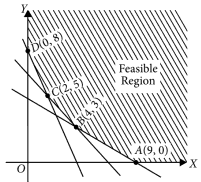
Feasible region for an L.P.P. is shown shaded in the following figure. Minimum of $Z=4 x+3 y$ occurs at the point
Image
$\left| {\,\begin{array}{*{20}{c}}{11}&{12}&{13}\\{12}&{13}&{14}\\{13}&{14}&{15}\end{array}\,} \right| = $
The point(s), at which the function $f$ given by $f(x)=\left\{\begin{array}{l}\frac{x}{|x|}, x<0 \\ -1, x \geq 0\end{array}\right.$ is continuous, is/are