MCQ
Davission and Germer experiment proved
  • A
    Wave nature of light
  • B
    Particle nature of light
  • C
    Both (a) and (b)
  • Neither (a) nor (b)

Answer

Correct option: D.
Neither (a) nor (b)
Davission and Germer proved the wave nature of electron by performing an experiment.

Need a full question paper?

Generate a complete, print-ready paper with questions like this in minutes — across 16+ boards, with answer keys.

Start Generating Free

Similar questions

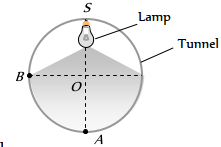
An electric lamp is fixed at the ceiling of a circular tunnel as shown is figure. What is the ratio the intensities of light at base $A$ and a point $B$ on the wall
Image
A block of mass $M$ is pulled along a horizontal frictionless surface by a rope of mass $m$. If a force $P$ is applied at the free end of the rope, the force exerted by the rope on the block will be
Heat given to a system is $35$ joules and work done by the system is $15$ joules. The change in the internal energy of the system will be
A pump motor is used to deliver water at a certain rate from a given pipe. To obtain twice as much water from the same pipe in the same time, power of the motor has to be increased to
Which of the following phenomena can explain quantum nature of light
Water drops fall at regular intervals from a tap which is $5 m$ above the ground. The third drop is leaving the tap at the instant the first drop touches the ground. How far above the ground is the second drop at that instant
A spring with spring constant $k$ is extended from $x=0$ to $x=x_1$.The work done will be
A particle moves in a circular orbit under the action of a central attractive force inversely proportional to the distance ' $r$ '. The speed of the particle is
In Gallilean telescope, if the powers of an objective and eye lens are respectively $+1.25\ D$ and $-20\ D$, then for relaxed vision, the length and magnification will be
Resistances $R_1$ and $R_2$ are joined in parallel and a current is passed so that the amount of heat liberated is $H_1$ and $H_2$ respectively. The ratio $\frac{H_1}{H_2}$ has the value