MCQ
de-Broglie hypothesis treated electrons as
  • A
    Particles
  • Waves
  • C
    Both ‘a’ and ‘b’
  • D
    None of these

Answer

Correct option: B.
Waves
Waves

Need a full question paper?

Generate a complete, print-ready paper with questions like this in minutes — across 16+ boards, with answer keys.
Start Generating Free

Similar questions

A coil having an area $2$m$^2$is placed in a magnetic field which changes from $1$ wb/m$^2$ to $4$ wb/m$^2$ in a interval of 2 second. The e.m.f. induced in the coil will be
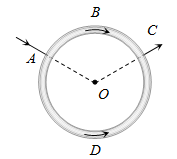
A uniform wire is bent in the form of a circle of radius R. A current I enters at A and leaves at C as shown in the figure :
If the length ABC is half of the length ADC, the magnetic field at the centre O will be
The magnitude of gravitational potential energy of the moon-earth system is U with zero potential energy at infinite separation. The kinetic energy of the moon with respect to the earth is K.
The diameter of the eye-ball of a normal eye is about $2.5\, cm$. The power of the eye lens varies from
When the distance between two charges is increased, the potential energy of the charges:
Two cells, having the same $e.m.f.$ are connected in series through an external resistance $R.$ Cells have internal resistances $r_1$ and $r_2\,\, (r_1 > r_2)$ respectively. When the circuit is closed, the potential difference across the first cell is zero. The value of $R$ is
Two magnets, each of magnetic moment $‘M’ $ are placed so as to form a cross at right angles to each other. The magnetic moment of the system will be
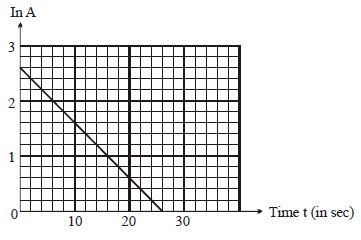
The graph in figure shows how the count-rate $A$ of a radioactive source as measured by a Geiger counter varies with time $t.$ The relationship between $A$ and $t$ is : $($ Assume $ln\,\, 12 = 2.6)$
The sun radiates energy in all directions. The average radiations received on the earth surface from the sun is $1.4\;kilowatt/{m^2}$.The average earth- sun distance is $1.5 \times {10^{11}}metres$. The mass lost by the sun per day is($1$ day $= 86400$ seconds)
Light with an energy flux of $20 W / cm ^2$ falls on a non-reflecting surface at normal incidence. If the surface has an area of $30 cm^2$. the total momentum delivered (for complete absorption) during $30$ minutes is: