MCQ
de-Broglie hypothesis treated electrons as
  • A
    Particles
  • Waves
  • C
    Both $‘a’$ and $‘b’$
  • D
    None of these

Answer

Correct option: B.
Waves
b
de-Broglie hypothesis treated electrons as waves.

Need a full question paper?

Generate a complete, print-ready paper with questions like this in minutes — across 16+ boards, with answer keys.

Start Generating Free

Similar questions

An average force of $125\,N$ is applied on a machine gun firing bullets each of mass $10\,g$ at the speed of $250\,m / s$ to keep it in position. The number of bullets fired per second by the machine gun is:
Which of the following does not turn Schiff's reagent to pink
An opaque sphere of radius a is just immersed in a transparent liquid as shown in figure. $A$ point source is placed on the vertical diameter of the sphere at a distance $a/2$ from the top of the sphere. One ray originating from the point source after refraction from the air liquid interface forms tangent to the sphere. The angle of refraction for that particular ray is $30^o$. The refractive index of the liquid is
If a coil made of conducting wires is rotated between poles pieces of the permanent magnet. The motion will generate a current and this device is called
A solid sphere, a hollow sphere and a ring are released from top of an inclined plane (frictionless) so that they slide down the plane. Then maximum acceleration down the plane is for (no rolling)   
The value of a unit vector in the direction of vector $A = 5\hat i - 12\hat j,$ is
One circular ring and one ciruclar disc, both are having the same mass and radius. the ratio of their moments of inertia about the axes passing through their centres and perpendicular to their planes, will be
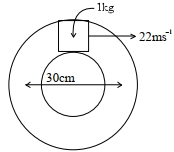
A closed circular tube of average radius $15\,cm$, whose inner walls are rough, is kept in vertical plane. A block of mass $1\,kg$ just fit inside the tube. The speed of block is $22\,m / s$, when it is introduced at the top of tube. After completing five oscillations, the block stops at the bottom region of tube. The work done by the tube on the block is $......J$. [Given $g=10\,m / s ^2$ ]
Consider the following statements. The total energy of a particle executing simple harmonic motion depends on its

$(1)$ Amplitude      $(2) $ Period         $(3)$ Displacement

Of these statements

An object is allowed to fall from a height $R$ above the earth, where $R$ is the radius of earth. Its velocity when it strikes the earth's surface, ignoring air resistance, will be :