Question
de Broglie wavelength associated with an electron accelerated through a potential difference V $\lambda$ is . What will be its wavelength when the accelerating potential is increased to 4 V?

Answer

$\lambda = \frac{\text{h}}{\sqrt{2\text{meV}}}$ or $\frac{12.27}{\sqrt{\text{V}}}\text{A}^{\circ}$
$\lambda' = \frac{12.27}{\sqrt{4\text{V}}}\text{A}^{\circ}$ or
 $\frac{\lambda}{2}$.

Need a full question paper?

Generate a complete, print-ready paper with questions like this in minutes — across 16+ boards, with answer keys.
Start Generating Free

Similar questions

What is the form of stored energy in any coil?
Name two semiconductor materials.
A steel rod of cross-sectional area 4cm2 and length 2m shrinks by 0.1cm as the temperature decreases in night. If the rod is clamped at both ends during the day hours, find the tension developed in it during night hours. Young's modulus of steel = 1.9 × 10¹¹N/m2.
What will be the value of maximum and minimum capacitances oblained from the combinations of three capacitors. each of which has a capacitance of $6 \mu F$ ?
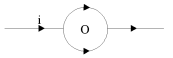
What is the magnetic field at O in the figure?
Image
The free electrons in a conducting wire are in constant thermal motion. If such a wire, carrying no current, is placed in a magnetic field, is there a magnetic force on each free electron? On the wire?
What is the importance of nuclear binding energy?
Suppose that the electric field part of an electromagnetic wave in vacuum is $\text{E}=\{(3.1 \ \text{N}/\text{C}\cos[(1.8 \text{rad}/ \text{m}) \text{y}+(5.4\times10^6 \ \text{red}/\text{s}\text{t}]\hat{\text{i}}\}$.
  1. What is the direction of propagation?
  2. What is the wavelength λ ?
  3. What is the frequency ν ?
  4. What is the amplitude of the magnetic field part of the wave?
  5. Write an expression for the magnetic field part of the wave.
If coherent waves of light produce destructive interference, then what will be the phase difference between them?
Figure shows a glowing mercury tube. The intensities at point A, B and C are related as:

  1. B > C > A
  2. A > C > B
  3. B = C > A
  4. B = C < A