Question
de Broglie wavelength associated with an electron accelerated through a potential difference V is $\lambda$ What will be the de Broglie wavelength when the accelerating potential is increased to 4V?

Answer

$\frac{\gamma}{2}$Reason: de Broglie wavelength associated with electron is,
$\lambda=\frac{\text{h}}{\sqrt{2\text{meV}}}\Rightarrow\ \lambda\propto\frac{1}{\sqrt{\text{V}}}$
Obviously when accelerating potential becomes 4V, the de-Broglie wavelength reduces to half.

Need a full question paper?

Generate a complete, print-ready paper with questions like this in minutes — across 16+ boards, with answer keys.
Start Generating Free

Similar questions

If the radius of the nucleus of $Al ^{27}$ is 3.6 Fermi , then what will be the radius of the $Fe ^{125}$ nucleus?
Explain dielectric strength and dielectric breakdown.
An electron, an alpha particle and a proton have the same kinetic energy. Which one of these particles has (i) the shortest and (ii) the largest, de Broglie wavelength?
Assume that the magnetic field is uniform in a cubical region and is zero outside. Can you project a charged particle from outside into the field so that the particle describes a complete circle in the field?
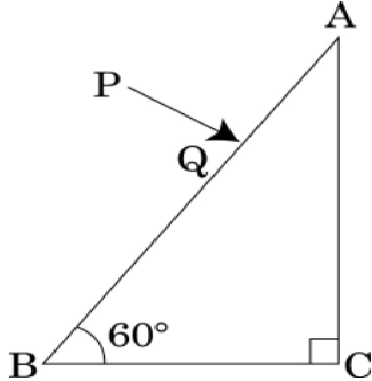
A ray PQ incident normally on the refracting face BA is refracting in the prism BAC made of material of refractive index1.5. Complete the path of ray through the prism. From which face will the ray emerge? Justify your answer.
Show that the electric field at the surface of a charged conductor is given by $\overrightarrow{\text{E}} = \frac{\sigma}{\varepsilon_{o}}\hat{\text{n}},$where σ is the surface charge density and $\hat{\text{n}}$is a unit vector normal to the surface in the outward direction.
What is magnetisation ? Derive the relationship between magnetisation and magnetic intensity.
Lithium (Z = 3) has two stable isotopes $^6Li$ and $^7Li.$ When neutrons are bombarded on lithium sample, electrons and $\alpha$-particles are ejected. Write down the nuclear process taking place.
State the conclusion of experiments about Iriction charge.
A tunnel is dug along a diameter of the earth. Find the force on a particle of mass m placed in the tunnel at a distance x from the centre.