MCQ
Decibel is unit of
  • A
    Intensity of light
  • B
    $X-rays$ radiation capacity
  • Sound loudness
  • D
    Energy of radiation

Answer

Correct option: C.
Sound loudness
c
Decibel $(dB)$, unit for expressing the ratio between two physical quantities, usually amounts of acoustic or electric power, or for measuring the relative loudness of sounds

Need a full question paper?

Generate a complete, print-ready paper with questions like this in minutes — across 16+ boards, with answer keys.

Start Generating Free

Similar questions

A body projected vertically from the earth reaches a height equal to earth's radius before returning to the earth. The power exerted by the gravitational force is greatest
In a two dimensional motion, instantaneous speed v0 is a positive constant. Then which of the following are necessarily true?
A force $\vec F = k[y\,\hat i\, + x\,\hat j]$ where $k$ is a positive constant acts on a particle moving in $x-y$ plane starting from the point $(3,5)$, the particle is taken along a straight line to $(5, 7)$. The work done by the force is : ............... $\mathrm{K}$
If $L , C$ and $R$ are the self inductance, capacitance and resistance respectively, which of the following does not have the dimension of time?
Two identical balls are interconnected with a massless and inextensible thread. The system is in gravity free space with the thread just taut. Each ball is imparted a velocity $v$, one towards the other ball and the other perpendicular to the first, at $t = 0$. Then,
A vibrating string of certain length $l$ under a tension $T$ reasonates with a mode corresponding to the first overtone (third harmonic) of an air column of length $75$ $cm$ inside a tube closed at one end. The string also generates $4$ beats per second when excited along with a tuning fork of frequency $n$. Now when the tension of the string is slightly increased the number of beats reduces to $2$ per second. Assuming the velocity of sound in air to be $340$ $m/s$, the frequency $n$ of the tuning fork in $Hz $ is
Given below are two statements: one is labelled as Assertion $A$ and the other is labelled as Reason $R$

Assertion $A:$ When you squeeze one end of a tube to get toothpaste out from the other end, Pascal's principle is observed.

Reason $R:$ A change in the pressure applied to an enclosed incompressible fluid is transmitted undiminished to every portion of the fluid and to the walls of its container.

In the light of the above statements, choose the most appropriate answer from the options given below

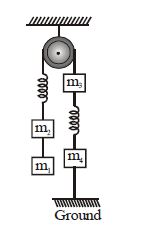
For the system shown in figure, $m_1>m_2>m_3 >m_4$ . Initially, the system is at rest in equilibrium condition. If the string joining $m_4$ and ground is cut, then just after the string is cut :

Statement $I$ $m_1$ ,$m_2$ ,$m_3$ remain stationary.

Statement $II$ The value of acceleration of all the $4$ blocks can be determined.

Statement $III$ Only $m_4$ remains stationary.

Statement $IV$ Only $m_4$ accelerates.

Statement $V$ All the four blocks remain stationary.

Now, choose the correct option.
Fountains usually seen in gardens are generated by a wide pipe with an enclosure at one end having many small holes. Consider one such fountain which is produced by a pipe of internal diameter $2$ $cm$ in which water flows at a rate $3$ $ms^{^{-1}}$. The enclosure has $100$ holes each of diameter $0.05$ $cm$. The velocity of water coming out of the holes ids ( in $ms^{^{-1}}$) 
The amount of energy required to form a soap bubble of radius $2\,cm$ from a soap solution is nearly $..........\,\times 10^{-4}\,J$: (surface tension of soap solution $=0.03\,N\,m ^{-1}$ )