Question
Decompose the vector $6\hat{\text{i}}-3\hat{\text{j}}-6\hat{\text{k}}$ into vectors which are parallal and perpendicular to the vector $\hat{\text{i}}+\hat{\text{j}}+\hat{\text{k}}.$

Answer

Let $\vec{\text{a}}=6\hat{\text{i}}-3\hat{\text{j}}-6\hat{\text{k}}$ and $\vec{\text{b}}=\hat{\text{i}}+\hat{\text{j}}+\hat{\text{k}}$
and $\vec{\text{x}}$ and $\vec{\text{y}}$ be such that
$\vec{\text{a}}=\vec{\text{x}}+\vec{\text{y}}$
$\Rightarrow\vec{\text{y}}=\vec{\text{a}}-\vec{\text{x}}\dots(1)$
Since $\vec{\text{x}}$ is parallel to $\vec{\text{b}},$
$\vec{\text{x}}=\text{t}\vec{\text{b}}$
$\Rightarrow\vec{\text{x}}=\text{t}\big(\hat{\text{i}}+\hat{\text{j}}+\hat{\text{k}}\big)=\text{t}\hat{\text{i}}+\text{t}\hat{\text{j}}+\text{t}\hat{\text{k}}\dots(2)$
Substituting the values of $\vec{\text{x}}$ and $\vec{\text{a}}$ in (1), we get 
$\vec{\text{y}}=6\hat{\text{i}}-3\hat{\text{j}}-6\hat{\text{k}}-\big(\text{t}\hat{\text{i}}+\text{t}\hat{\text{j}}+\text{t}\hat{\text{k}}\big)=(6-\text{t})\hat{\text{i}}+(-3-\text{t})\hat{\text{j}}+(-6-\text{t})\hat{\text{k}}\dots(3)$
Since $\vec{\text{y}}$ is perpendicular to $\vec{\text{b}},$
$\vec{\text{y}}.\vec{\text{b}}=0$
$\Rightarrow\big[(6-\text{t})\hat{\text{i}}+(-3-\text{t})\hat{\text{j}}+(-6-\text{t})\hat{\text{k}}\big].\big(\hat{\text{i}}+\hat{\text{j}}+\hat{\text{k}}\big)=0$
$\Rightarrow1(6-\text{t})+1(-3-\text{t})+1(-6-\text{t})=0$
$\Rightarrow-3-3\text{t}=0$
$\Rightarrow\text{t}=-1$
From (2) and (3), we get
$\vec{\text{x}}=-\hat{\text{i}}-\hat{\text{j}}-\hat{\text{k}}$
$\vec{\text{y}}=7\hat{\text{i}}-2\hat{\text{j}}-5\hat{\text{k}}$
So,
$\vec{\text{a}}=\vec{\text{x}}+\vec{\text{y}}=\big(-\hat{\text{i}}-\hat{\text{j}}-\hat{\text{k}}\big)+\big(7\hat{\text{i}}-2\hat{\text{j}}-5\hat{\text{k}}\big)$

Need a full question paper?

Generate a complete, print-ready paper with questions like this in minutes — across 16+ boards, with answer keys.
Start Generating Free

Similar questions

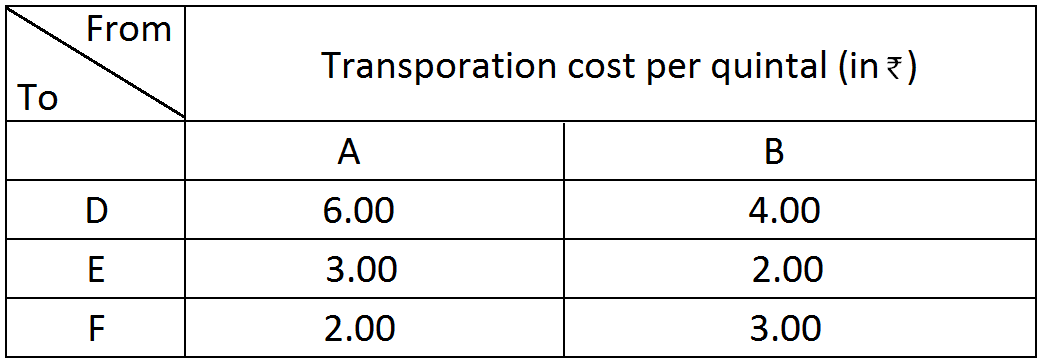
 Tow godowns, A and B, have grain storage capacity of 100 quintals and 50 quintals respectively. They supply to 3 ration shops, D, E and F, whose requirements are 60, 50 and 40 quintals respectively. The cost of transportation per quintal from the godowns to the shops are given in the following table:

How should the supplies be transported in order that the transportation cost is minimum? 

A test for detection of a particular disease is not fool proof. The test will correctly detect the disease 90% of the time, but will incorrectly detect the disease 1% of the time. For a large population of which an estimated 0.2% have the disease, a person is selected at random, given the test, and told that he has the disease. What are the chances that the person actually have the disease?
Differentiate the following functions with respect to x:
$\frac{2^\text{x}\cos\text{x}}{(\text{x}^2+3)^2}$
Evaluate:

$\DeclareMathOperator*{\median}{\text{lim}} \median_{\text{x}\rightarrow0}\frac{\text{tan x - sin x}}{\sin^{3}\text{x}}$.

Find the area bounded by the curve x = 4y and the line x = 4y - 2.
Verify Rolle's theorem of the following function on the indicated interval
$\text{f}(\text{x})=\sin^4\text{x}+\cos^4\text{x}\text{ on }\Big[0,\frac{\pi}{2}\Big]$
A manufacturer has three machines installed in his factory. machines I and II are capable of being operated for at most 12 hours whereas Machine III must operate at least for 5 hours a day. He produces only two items, each requiring the use of three machines. The number of hours required for producing one unit each of the items on the three machines is given in the following table:
Item Number of hours required by the machine
  I II III
A 1 2 1
B 2 1 $\frac{5}{4}$
He makes a profit of Rs. 6.00 on item A and Rs. 4.00 on item B. Assuming that he can sell all that he produces, how many of each item should he produces so as to maximize his profit? Determine his maximum profit. Formulate this LPP mathematically and then solve it.
A trust invested some money in two type of bonds. The first bond pays 10% interest and bond pays 12% interest. The trust received 2,800 as interest. However, if trust had interchanged money in bonds, they would have got 100 less as interest. Using matrix method, find the amount invested by the trust. Which value is reflected in this question?
Determine the binomial distribution whose mean is 20 and variance 16.
By Using properties of definite integrals, evaluate the following integral in Exercise:
$\int^{\pi}_{0}\log(1+\cos\text{x})\text{dx}$