Question
Define
(a) Circular motion (b) Centripetal force (c) Centrifugal force

Answer

(a) Circular motion - The motion of a body in a circular path with uniform speed but variable velocity, such that it is acted upon by an acceleration is called circular motion.
(b) Centripetal force - A force which is directed towards the centre of a circular path and always acts at right angles to the direction of motion is called centripetal force,
(c) Centrifugal force - The force acting on a body away from the centre of its circular path along the radius is called centrifugal force,

Need a full question paper?

Generate a complete, print-ready paper with questions like this in minutes — across 16+ boards, with answer keys.

Start Generating Free

Similar questions

What is the purpose of a machine?
Two sounds A and B are of same amplitude, same wave forms but of frequencies f and 2f respectively. Then:

  • B differs in quality from A

  • B is grave, A is shrill

  • B is shrill, A is grave

  • B is louder than A

The temperature of a lead piece of mass 400 g rises from 20°C to 50°C when 1560 J of heat is supplied to it. Calculate: Heat capacity of lead piece.
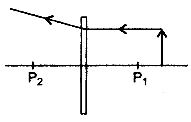
Copy the following figure and complete it to show the formation of the image of the object AB. Name the lens used in the figure.
Two sounds of same loudness and same pitch produced by two different instruments differ in their:

  • Amplitudes

  • Frequencies

  • Waveforms

  • All of the above.

Name the two scales used for measuring temperature.
Define the term kilowatt - hour and state its value in $S.I.$ unit.
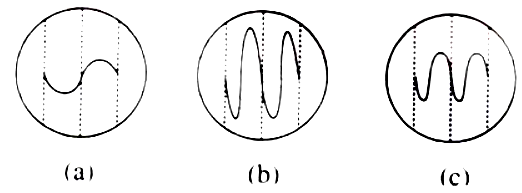
A microphone is connected to the Y-input of a C.R.O Three different sounds are made in turn in front of the microphone. Their traces (a), (b) and (c) produces on the screen are shown in following figure .


(i) which trace is due to the loudest sound? Give reason for your answer.
(ii) Which trace is due for the sound with the lowest pitch? Explain your answer.
What is the ratio of SI units to $CGS$ units of 'work'?
The refractive index of air with respect to glass is expressed as
$g \mu a=\frac{\sin i}{\sin r}$
(a) Write down a similar expression for a $\mu g$ in terms of the angles $i$ and $r$.
(b) if angle $r =90^{\circ}$, what is the corresponding angle i called?
(c) what is the physical significance of the angle $i$ in part (b)?