Question
Define a magnet and write its characteristics of directive property and pole strength.

Answer

Such a substance which attracts other magnetic substances such as iron etc. towards itself and when it is suspended freely, then it rests in north-south direction. Its two and equal opposite poles are separated by some distance.
Directive property : When any bar magnet is suspended freely, it always rests in a definite direction. Its one end is towards the north and the other is towards the south which are known as north pole and south pole respectively. A bar magnet always exhibits north and south direction.
Pole strength : Strength of magnetisation of magnetic poles is known as pole strength. Pole strength of both poles of a bar magnet is same. If a bar magnet is cut perpendicular to its axis, then pole strength of poles of each part will almost be same as of original magnet and if it is cut in to equal parts along its axis, then pole strength of each part will be half that of original bar magnet.
Need a full question paper?

Generate a complete, print-ready paper with questions like this in minutes — across 16+ boards, with answer keys.

Start Generating Free

Similar questions

A straight wire of length l can slide on two parallel plastic rails kept in a horizontal plane with a separation d. The coefficient of friction between the wire and the rails is $\mu.$ If the wire carries a current i, what minimum magnetic field should exist in the space in order to slide the wire on the rails?
  1. Derive Snell's law on the basis of Huygen's wave theory when light is travelling from a denser to a rarer medium.
  2. Draw the sketches to differentiate between plane wavefront and spherical wavefront.
How does an unpolarised light get polarised when passed through a polaroid?
Two polaroids are set in crossed positions. A third polaroid is placed between the two making an angle θ with the pass axis of the first polaroid. Write the expression for the intensity of light transmitted from the second polaroid. In what orientations will the transmitted intensity be (i) minimum and (ii) maximum?
When a photon is emitted from an atom, the atom recoils. The kinetic energy of recoil and the energy of the photon come from the difference in energies between the states involved in the transition. Suppose, a hydrogen atom changes its state from n = 3 to n = 2. Calculate the fractional change in the wavelength of light emitted, due to the recoil.
A capacitor of unknown capacitance is connected across a battery of V volts. The charge stored in it is 360 $\mu$C. When potential across the capacitor is reduced by 120 V, the charge stored in it becomes 120 $\mu$C.
Calculate:
  1. The potential V and the unknown capacitance C.
  2. What will be the charge stored in the capacitor, if the voltage applied had increased by 120 V?
Show that the wavelength of electromagnetic radiation is equal to the de Broglie wavelength of its quantum (photon).
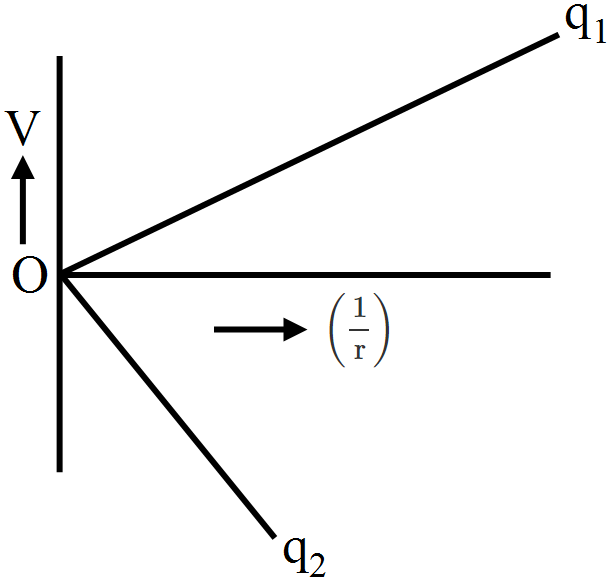
The two graphs are drawn below, show the variations of electrostatic potential (V) $\frac{1}{\text{r}}$ (r being the distance of field point from the point charge) for two point charges $q_1$ and $q_2.$​​​​​​​
  1. What are the signs of the two charges?
  2. Which of the two charges has the larger magnitude and why?
​​​​​​​​​​​​​​
Given n resistors each of resistance R, how will you combine them to get the (i) maximum (ii) minimum effective resistance? What is the ratio of the maximum to minimum resistance?
Using truth tables of AND gate and NOT gate show that NAND gate is an AND gate followed by a NOT gate. Hence write the truth table of NAND gate.
Why are NAND gates called ‘Universal Gates’?
Whenever a photon is emitted by hydrogen in Balmer series, it is followed by another photon in Lyman series. What wavelength does this latter photon correspond to?