Question
Define a magnet and write its characteristics of directive property and pole strength.

Answer

Such a substance which attracts other magnetic substances such as iron etc. towards itself and when it is suspended freely, then it rests in north-south direction. Its two and equal opposite poles are separated by some distance.
Directive property : When any bar magnet is suspended freely, it always rests in a definite direction. Its one end is towards the north and the other is towards the south which are known as north pole and south pole respectively. A bar magnet always exhibits north and south direction.
Pole strength : Strength of magnetisation of magnetic poles is known as pole strength. Pole strength of both poles of a bar magnet is same. If a bar magnet is cut perpendicular to its axis, then pole strength of poles of each part will almost be same as of original magnet and if it is cut in to equal parts along its axis, then pole strength of each part will be half that of original bar magnet.

Need a full question paper?

Generate a complete, print-ready paper with questions like this in minutes — across 16+ boards, with answer keys.

Start Generating Free

Similar questions

A long, cylindrical tube of inner and outer radii a and b carries a current i distributed uniformly over its cross section. Find the magnitude of the magnetic field at a point (a) just inside the tube (b) just outside the tube.
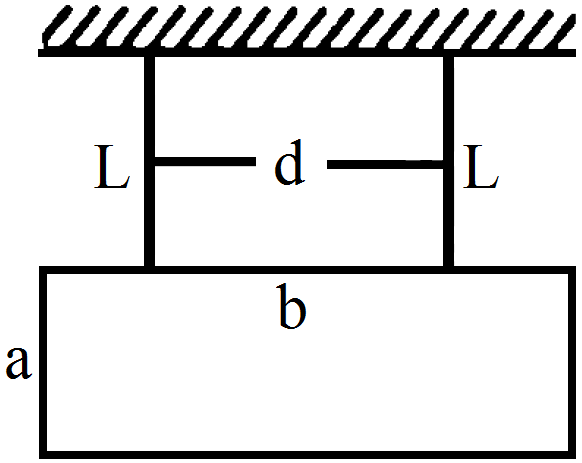
A rectangular plate of sides a and b is suspended from a ceiling by two parallel strings of length L each figure The separation between the strings is d. The plate is displaced slightly in its plane keeping the strings tight. Show that it will execute simple harmonic motion. Find the time period.

A short bar magnet placed in a horizontal plane has its axis aligned along the magnetic north-south direction. Null points are found on the axis of the magnet at 14 cm from the centre of the magnet. The earth’s magnetic field at the place is 0.36 G and the angle of dip is zero. What is the total magnetic field on the normal bisector of the magnet at the same distance as the null–point (i.e., 14 cm) from the centre of the magnet? (At null points, field due to a magnet is equal and opposite to the horizontal component of earth’s magnetic field.)
Iron emits $\text{K}_\alpha$ X-ray of energy 6.4keV and calcium emits $\text{K}_\alpha$ X-rays of energy 3.69 keV. Calculate the times taken by an iron $\text{K}_\alpha$ photon to cross through a distance of 3km.
Careful measurement of the electric field at the surface of a black box indicates that the net outward flux through the surface of the box is 8.0 × 10³ Nm2 /C.
  1. What is the net charge inside the box?
  2. If the net outward flux through the surface of the box were zero, could you conclude that there were no charges inside the box? Why or Why not?
Two capacitors of capacitances $4.0\mu\text{F}$ and $6.0\mu\text{F}$ are connected in series with a battery of 20V. Find the energy supplied by the battery.
Consider a head-on collision between two particles of masses m1 and m2. The initial speeds of the particles are u1 and u2 in the same direction. The collision starts 2 at t = 0 and the particles interact for a time interval $\triangle\text{t}.$ During the collision, the speed of the first particle varies as.

$\text{v}(\text{t})=\text{u}_1+\frac{\text{t}}{\triangle\text{t}}(\text{v}_1-\text{u}_1).$

Find the speed of the second particle as a function of time during the collision.

Which waves are electromagnetic waves?Which factors are responsible for their production?
Can X-rays be used for photoelectric effect?