Question
Define a trial.

Answer

What is the meaning of trial?
The word trial means a test of performance, qualities, or suitability.
Definition:
Any particular performance of a random experiment is called a trial.
That is, when we perform an experiment it is called a trial of the experiment.
By experiment or trial, we mean a random experiment unless otherwise specified.
Where you are required to differentiate between a trial and an experiment, consider the experiment to be a larger entity formed by the combination of a number of trials.
To illustrate the definition, let us take examples:
$1.$ In the experiment of tossing $4$ coins, we may consider tossing each coin as a trial and therefore say that there are $4$ trials in the experiment.
$2.$ In the experiment of rolling a dice $5$ times, we may consider each rolls as a trial and therefore say that there are $5$ trials in the experiment.
Note that rolling a dice $5$ times is same as rolling $5$ dices each one time. Similarly, tossing $4$ coins is same as tossing one coin $4$ times.

Need a full question paper?

Generate a complete, print-ready paper with questions like this in minutes — across 16+ boards, with answer keys.
Start Generating Free

Similar questions

The time taken, in seconds, to solve a problem by each of $25$ pupils is as follows:
$16, 20, 26, 27, 28, 30, 33, 37, 38, 40, 42, 43, 46, 46, 46, 48, 49, 50, 53, 58, 59, 60, 64, 52, 20$.
$a.$ Construct a frequency distribution for these data, using a class interval of $10$ seconds.
$b.$ Draw a histogram to represent the frequency distribution.
In a right triangle, prove that the line-segment joining the mid-point of the hypotenuse to the opposite vertex is half the hypotenuse.
If $AD$ is a median of a triangle $ABC$, then prove that triangles $ADB$ and $ADC$ are equal in area. If $G$ is the mid-point of median $AD$, prove that $\text{ar}(\triangle\text{BGC})=\text{ar}(\triangle\text{AGC}).$
$A B C D$ is a parallelogram. $P$ is the mid-point of $A B$. $B D$ and $C P$ intersect at $Q$ such that $C Q: Q P=3: 1$. If $\operatorname{ar}(\triangle PBQ )=10\ cm^2$, find the area of parallelogram $ABCD$ .
Question 15: Two lines $l$ and $m$ intersect at the point $0$ and $P$ is a point on a line $n$ passing through the point $0$ such that $P$ is equidistant from $l$ and $m.$ Prove that $n$ is the bisector of the angle formed by $l$ and $m.$
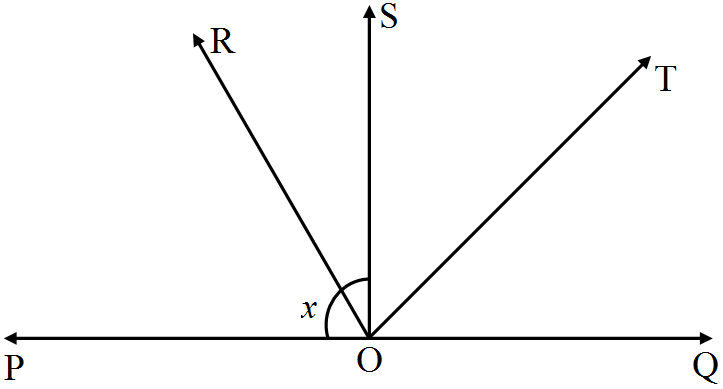
In figure, ray $OS$ stand on a line $POQ$. Ray $OR$ and ray $OT$ are angle bisectors of $\angle\text{POS}$ and $\angle\text{SOQ}$ respectively. If $\angle\text{POS}=\text{x},$ find $\angle\text{ROT}.$
Prove that the line segment joining the mid-point of the hypotenuse of a right triangle to its opposite vertex is half of the hypotenuse.
$ABC$ is a triangle in which $\angle\text{B}=2\angle\text{C}.$ $D$ is a point on $BC$ such that $AD$ bisects $\angle\text{BAC}$ and $\text{AB}=\text{CD}.$ Prove that $\angle\text{BAC}=72^\circ.$
$ABCD$ is a trapezium in which $AB || DC, DC = 30\ cm$ and $AB = 50\ cm.$ If $X$ and $Y$ are, respectively the mid-points of $AD$ and $BC,$ prove that $\text{ar}(\text{DCYX})=\frac{7}{9}\ \text{ar}(\text{XYBA})$
In Fig.$9\ PSDA$ is a parallelogram. Points $Q$ and $R$ are taken on $PS$ such that $PQ = QR = RS$ and $PA || QB || RC.$ Prove that $ar\ (PQE) = ar\ (CFD). $