Question
Define absolute pressure.

Answer


Definition: The absolute pressure, or total press-ure, is measured relative to absolute zero on the pressure scale-which is a perfect vacuum-and is the sum of gauge pressure and atmospheric press-ure. It is the same as the thermodynamic pressure.Absolute pressure accounts for the atmospheric pressure, which in effect adds to the pressure in any fluid which is not enclosed in a rigid container i.e., the fluid is open to the atmosphere.
$
\mathrm{p}=\mathrm{p}_0+\mathrm{P}_{\mathrm{g}}
$
where $p_0$ and $p_g$ are respectively atmospheric pressure and the gauge pressure.
Absolute pressure can be never negative.

Need a full question paper?

Generate a complete, print-ready paper with questions like this in minutes — across 16+ boards, with answer keys.
Start Generating Free

Similar questions

An electron in an atom revolves around the nucleus in an orbit of radius $0.53 \mathring A $. If the frequency of revolution of an electron is $9 \times 10^9 MHz$, calculate the equivalent magnetic moment. $\left[e=1.6 \times 10^{-19} C \right]$
Find the temperature at which
(i) the rms speed
(ii) the average kinetic energy of the molecules of an ideal gas are double their respective values at STP.
The kinetie energy of nitrogen per unit mass at \(300 K\) is \(2.5 \times 10^6 J / kg\). Find the kinetie energy of \(4 kg\), oxygen at \(600 K\).
(Molecular weight of nitrogen = 28, Molecular weight of oxygen - 32)
An infinitely long positively charged straight wire has a linear charge density $\lambda$. An electron is revolving around the wire as its centre with a constant speed in a circular plane perpendicular to the wire. Deduce the expression for its kinetic energy.
The thermal efficiency of a heat engine is $25 \%$. If in one cycle the heat absorbed from the hot reservoir is $50000 J$, what is the heat rejected to the cold reservoir in one cycle?
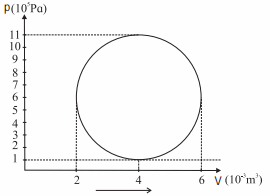
A hypothetical thermodynamic cycle is shown in the figure. Calculate the work done in $25$ cycles.

Image
 
Explain the working of LED.
Obtain an expression for the resultant amplitude of, the composition of two S.H.M.’s having the same period along the same path.
State the expression for the Ml of a thin spherical shell (i.e., a thin-walled hollow sphere) about its diameter. Hence obtain the expression for its $\mathrm{Ml}$ about a tangent.
State any two sources of errors in the meter-bridge experiment. Explain how they can be minimized.