Question
  1. Define ‘activity’ of a radioactive material and write its S.I. unit.
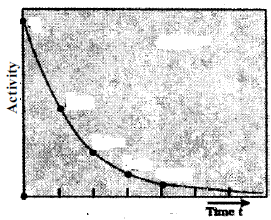
  2. Plot a graph showing variation of activity of a given radioactive sample with time.
  3. The sequence of stepwise decay of a radioactive nucleus is

If the atomic number and mass number of D2 are 71 and 176 respectively, what are their corresponding values for D?
Answer

  1. The total decay rate (of a sample)at the given instant, i.e., the number of radionuclides disintegrating per unit time is called the activity of that sample. The SI unit for activity is becquerel (Bq).
  2. Graph:

  1. 72 and 180.

Need a full question paper?

Generate a complete, print-ready paper with questions like this in minutes — across 16+ boards, with answer keys.

Start Generating Free

Similar questions

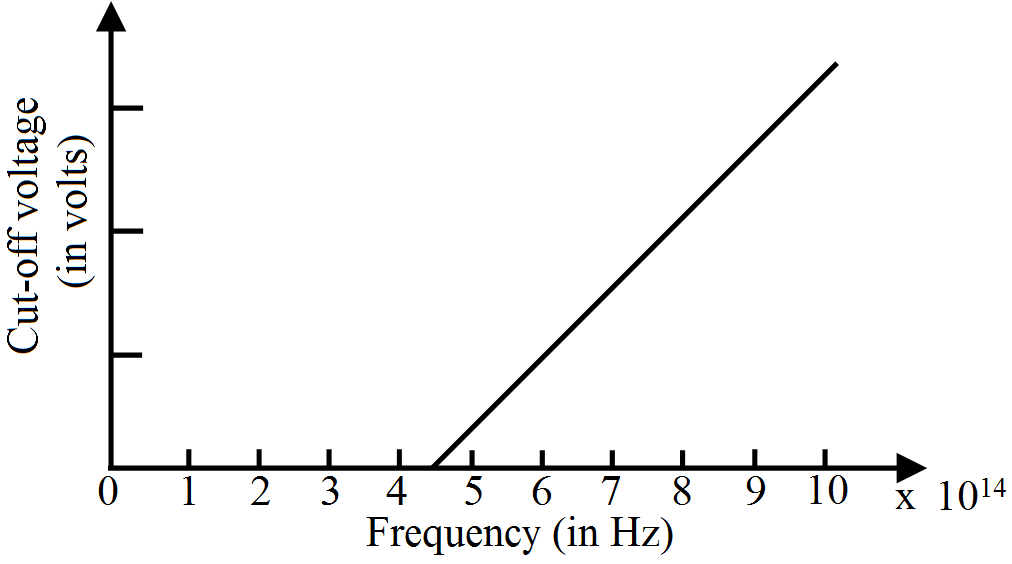
For photoelectric effect in sodium, the figure shows the plot of cut-off voltage versus frequency of incident radiation. Calculate,

  1. Threshold frequency.
  2. Work function for sodium.
Potential at an instant $t$ in an ac circuit is $E=200 \sin 157 t . \cos 157 t$ volts and current is $I=\sin \left(314 t+\frac{\pi}{3}\right) \quad$ Amperes. In this condition calculate :
(a) frequency
(b) root mean square value of voltage
(c) impedance of the circuit
(d) power factor.
A spy report about a suspected car reads as follows. "The car moved 2.00km towards east, made a perpendicular left turn, ran for 500m, made a perpendicular right turn, ran for 4.00km and stopped". Find the displacement of the car.
Explain use of juction diode as full wave rectifier.
What should be the condition for the efficiency of a Carnot engine to be equal to 1?
Two sources of sound, S1 and S2, emitting waves of equal wavelength 20.0cm, are placed with a separation of 20.0cm between them. A detector can be moved on a line parallel to S1S2, and at a distance of 20.0cm from it. Initially, the detector is equidistant from the two sources. Assuming that the waves emitted by the sources are in phase, find the minimum distance through which the detector should be shifted to detect a minimum of sound.
Distinguish between nuclear fission and fusion. Show how in both these processes energy is released. Calculate the energy release in MeV in the deuterium-tritium fusion reaction:
$^{2}_{1}\text{H} + ^{3}_{1}\text{H}\rightarrow^{4}_{2}\text{H} +\text{n}$
Using the data:
$\text{m}(^{2}_{1}\text{H}) = 2.014102 \text{u}$
$\text{m}(^{3}_{1}\text{H}) = 3.016049\text{u}$
$\text{m}(^{4}_{2}\text{H}) = 4.002603 \text{u}$
$\text{m}_{n} = 1.008665 \text{n}$
$1\text{u} = 931.5\text{MeV/c}^{2}$.
Power factor of a coil in an ac circuit at 60 hertz frequency is 0.707 . If frequency of ac source becomes 120 hertz, then what will be power factor?
A radioactive material is reduced to $\frac{1}{16}$ of its original amount in 4 days. How much material should one begin with so that 4 × 10⁻³kg of the material is left after 6 days?
What is the de Broglie wavelength of a nitrogen molecule in air at 300 K? Assume that the molecule is moving with the root-meansquare speed of molecules at this temperature. (Atomic mass of nitrogen = 14.0076 u).