Question
  1. Define ‘activity’ of a radioactive material and write its S.I. unit.
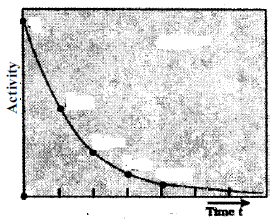
  2. Plot a graph showing variation of activity of a given radioactive sample with time.
  3. The sequence of stepwise decay of a radioactive nucleus is


If the atomic number and mass number of $D_2$ are 71 and 176 respectively, what are their corresponding values for D?
Answer

  1. The total decay rate (of a sample)at the given instant, i.e., the number of radionuclides disintegrating per unit time is called the activity of that sample. The SI unit for activity is becquerel (Bq).
  2. Graph:
  1. 72 and 180.

Need a full question paper?

Generate a complete, print-ready paper with questions like this in minutes — across 16+ boards, with answer keys.

Start Generating Free

Similar questions

Write a short-note on p-type semiconductors.
Answer the following questions:
If χ-stands for the magnetic susceptibility of a given material, identity the class of materials for which $(\text{i})-1 \geq\text{X} < 0 (\text{ii}) 0< \text{X} < \varepsilon 0 (\varepsilon$ is a small positive number).
  1. Write the range of relative magnetic permeability of these materials.
  2. Draw the pattern of the magnetic field lines when these materials are placed on an strong magnetic field.
A charge of 1.0C is placed at the top of your college building and another equal charge at the top of your house. Take the separation between the two charges to be 2.0km. Find the force exerted by the charges on each other. How many times of your weight is this force?
  1. Why photoelectric effect can not be explained on the basis of wave nature of light? Give reasons.
  2. Write the basic features of photon picture of electromagnetic radiation on which Einstein’s photoelectric equation is based.
Magnitude of electric field of a plane electromagnetic wave is $40 V / m$ and it vibrates with a frequency of $2 \times 10^{10} s^{-1}$. Calculate the wavelength of the wave.
Draw the graph of binding energy per nucleon against atomic mass number and draw conclusion of the graph.
The temperature and relative humidity in a room are 300K and 20% respectively. The volume of the room is $50m^3.$ The saturation vapour pressure at 300K is 3.3kPa. Calculate the mass of the water vapour present in the room.
A charge of $3.14 \times 10^{-6}C$ is distributed uniformly over a circular ring of radius 20.0cm. The ring rotates about its axis with an angular velocity of 60.0 rad/s. Find the ratio of the electric field to the magnetic field at a point on the axis at a distance of 5.00cm from the centre.
Obtain the de Broglie wavelength associated with thermal neutrons at room temperature (27ºC). Hence explain why a fast neutron beam needs to be thermalised with the environment before it can be used for neutron diffraction experiments.