Question
Define an acid salt and a normal salt.

Answer

Acid Salt : The salt formed by the partial replacement of the replacable hydrogen atoms of an acid molecule by a metallic or ammonium ion is called acid salts.
For example : $NaHSO_{4 ,}Na_2HPO_4$.

Normal Salt : The salt formed by replacement of all the replacebale hydrogen atoms of an acid by metallic or ammonium ions is called a normal salt.
For example : $NaCI , Na_2SO_4$.

Need a full question paper?

Generate a complete, print-ready paper with questions like this in minutes — across 16+ boards, with answer keys.

Start Generating Free

Similar questions

Mention the colour changes observed when the following indicators are added:
Solution Acids Alkalies
(a) Alkaline phenolphthalein solution (b) Methyl orange solution (c) Neutral litmus solution    
24 cc Marsh gas $\left( CH _4\right)$ was mixed with $106 cc$ oxygen and then exploded. On cooling the volume of the mixture became $82 cc$ , of which, $58 cc$ was unchanged oxygen. Which law does this experiment support? Explain with calculations.
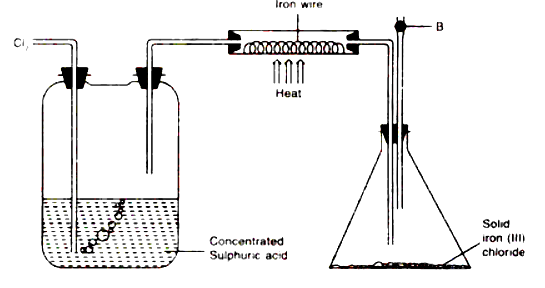
The diagram given below is to prepare iron (III) chloride in the laboratory.

(i) What is substance B?
(ii) What is the purpose of B?
(iii)Why is iron (III) chloride to be stored in a closed container?
(iv) Write the equation for the reaction between iron and chloride ?
A solid is crystalline, has a high melting point and is water soluble. Describe the nature of the solid.
Name the chloride of a metal which is soluble in excess of ammonium hydroxide. Write equation for the same.
Comment on the statement that- "All ores are minerals but all minerals are not ores".
X, Y, and Z are three crystalline solids that are soluble in water and have common anion. To help you to identify X, Y and Z you are provided with the following experimental observations. Copy and complete the corresponding inferences in (a) to (e).
(a) A reddish-brown gas is obtained when X, Y, and Z are separately warmed with concentrated sulphuric acid and copper turning added to the mixture.
Inference 1: The common anion is _____ion.
(b) When X is heated, it melts and gives off only one gas which re-lights a glowing splint.
Inference2: The cation in X is either _____ or _____.
(c) The action of heat on Y produces a reddish-brown gas and yellow residue which fuses with a glass of the test tube.
Inference3: The metal ion present in Y is the____ ion.
(d) When Z is heated, it leaves no residue. Warming Z with sodium hydroxide solution liberates a gas that turns moist red litmus paper blue.
Inference4: Z contains the ____ cation.
(e) Write the equations for the following reactions:
  1. X and concentrated sulphuric acid (below $200^oC$). (One equation only for either of the cations given in Inference 2)
  2. The action of heat on Y.
  3. Concentrated nitric acid is added to copper turnings kept in a beaker.
Electrolysis is used in the purification of metals. Name (i) anode (ii) cathode (iii) electrolyte you would use to get pure copper from a piece of impure copper.
The reaction $4N_2O + CH_4 \rightarrow CO_2 + 2H_2O + 4N_2$ takes place in the gaseous state. If the volumes of all the gases are measured at the same temperature, and pressure, calculate the volume of dinitrogen oxide $(N_2O),$ required to give $150\ cm^3$ of steam.
Give reason for the following:
In the laboratory preparation of nitric acid, the mixture of concentrated sulphuric acid and sodium nitatre should not be heated very strongly, above 200°C