Question
Define atomic mass unit.

Answer

Atomic Mass Unit : The mass of nuclear particle proton, neutron is so low that when expressed in kilogram units, they are of the order $10^{-27} kg$. It is not very convenient to use such small quantities. Therefore the masses of nuclei are expressed in a smaller unit. It is called atomic mass unit (a.m.u.). Considering the mass of ${ }_6 C ^{12}$ as standard, its 12 th part is equal to 1 a.m.u.
$\begin{aligned}
\text { That is, } 1 \text { a.m.u. } & =\frac{\text { Mass of } C^{12} \text { atom }}{12} \\
& =1.660565 \times 10^{-27} kg
\end{aligned}$

Need a full question paper?

Generate a complete, print-ready paper with questions like this in minutes — across 16+ boards, with answer keys.
Start Generating Free

Similar questions

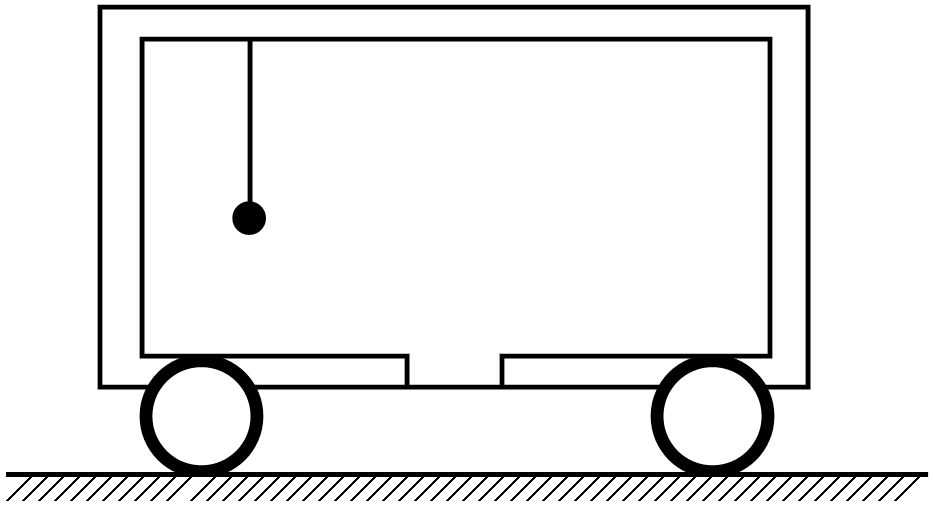
A cart of mass M is at rest on a frictionless horizontal surface and a pendulum bob of mass m hangs from the roof of the cart. The string breaks, the bob falls on the floor, makes several collisions on the floor and finally lands up in a small slot made in the floor. The horizontal distance between the string and the slot is L. Find the displacement of the cart during this process.
A resistor of 100 $\Omega$ and a capacitor of $100 / \pi\mu\text{F}$ are connected in series to a 220 V, 50 Hz a.c. supply.
  1. Calculate the current in the circuit.
  2. Calculate the (rms) voltage across the resistor and the capacitor. Do you find the algebraic sum of these voltages more than the source voltage? If yes, how do you resolve the paradox?
Photoelectrons are emitted from a metal surface when illuminated with $UV$ light of wavelength $330 nm$ . The minimum amount of energy required to emit the electrons from the surface is $3.5 \times 10^{-19} J$. Calculate :
$a$. the energy of the incident radiation, and
$b$. the kinetic energy of the photoelectron.
A converging lens and a diverging mirror are placed at a separation of 15cm. The focal length of the lens is 25cm and that of the mirror is 40cm. Where should a point source be placed between the lens and the mirror so that the light, after getting reflected by the mirror and then getting transmitted by the lens, comes out parallel to the principal axis?
Use Bohr’s postulates hydrogen atom to deduce the expression for the kinetic energy $(K.E.)$ of the electron revolving in the $n^{th}$ orbit and show that, $K.E. \frac{\text{e}^{2}}{8\pi\varepsilon_{0}\text{ e}_{n}} , $ where $r_n$ is the radius of the $n^{th}$ orbit. How is the orbit. How is the potential energy in the orbit related to the orbital radius orbit related to the orbital radius $r_n?$
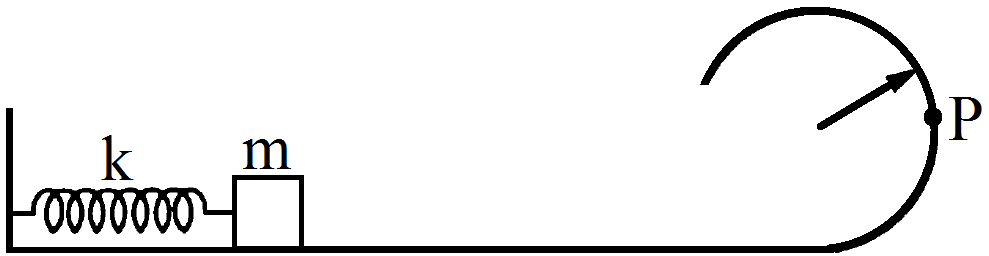
A block of mass $100g$ is moved with a speed of $5.0m/s$ at the highest point in a closed circular tube of radius $10\ cm$ kept in a vertical plane. The cross$-$section of the tube is such that the block just fits in it. The block makes several oscillations inside the tube and finally stops at the lowest point. Find the work done by the tube on the block during the process.
Using Biot-Savart law, deduce the expression for the magnetic field at a point (x) on the axis of a circular current carrying loop of radius R. How is the direction of the magnetic field determined at this point?
Light in certain cases may be considered as a stream of particles called photons. Each photon has a linear momentum $\frac{\text{h}}{\lambda}$ where h is the Planck's constant and $\lambda$ is the wavelength of the light. A beam of light of wavelength $\lambda$ is incident on a plane mirror at an angle of incidence $\theta.$ Calculate the change in the linear momentum of a photon as the beam is reflected by the mirror.

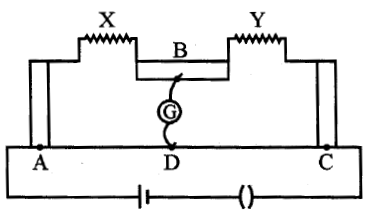
The figure shows experimental set up of a meter bridge. When the two unknown resistances X and Y are inserted, the null point D is obtained 40 cm from the end A. When a resistance of 10 Ω is connected in series with X, the null point shifts by 10 cm. Find the position of the null point when the 10 Ω resistance is instead connected in series with resistance ‘Y’. Determine the values of the resistances X and Y.
A simple pendulum consists of a 50cm long string connected to a 100g ball. The ball is pulled aside so that the string makes an angle of 37° with the vertical and is then released. Find the tension in the string when the bob is at its lowest position.