Question
Define diamagnetic, paramagnetic and ferromagnetic substance with examples. Explaining the meaning of domain explain ferromagnetism.
Answer

Diamagnetic Substances : Diamagnetic sub-stances are those which acquire feeble magnetisation in a direction opposite to that of magnetising field i.e. for these materials $\overrightarrow{ I }$ is always opposite to $\overrightarrow{ H }$. Therefore when these substances are brought close to a pole of a powerful magnet they are somewhat repelled away from the material. Due to this fact the susceptibility $(\chi)$ of these substances is negative.
Examples : Bismuth, antimony, gold, water, alcohol, quartz, copper, lead, zinc, tin, silicon, nitrogen, sodium-chloride etc.
Paramagnetic Substances : Paramagnetic sub-stances are those which, when placed in a magnetic field, acquire a feeble magnetisation in the same sense as the applied field. i.e. for these substances $\overrightarrow{ I }$ is always in the direction of $\overrightarrow{ H }$. Therefore, when these substances are brought close to any pole of a powerful magnet, they are attracted towards the magnet. Due to this fact the susceptibility of these substances is positive.
Examples : Platinum, aluminium chromium, manganese copper sulphate, solution of salts of iron and nickel, oxygen, crow glass, radium, copper chloride etc.
Ferromagnetic Substances : Those substances which when placed in a magnetic field are strongly magnetised in the direction of magnetising field are called ferromagnetic substances. For such substances $\overrightarrow{ I }$ is always in the direction of $\overrightarrow{ H}$ and $\overrightarrow{ I }$ is much greater than $\overrightarrow{H }$. Therefore when these substances are brought close to any pole of a magnet, they are strongly attracted by the magnet. Due to this fact the susceptibility \[(\chi\] = I/H) of ferromagnetic substances is positive and is very much greater than 1.
Examples : Iron, Cobalt, Nickel, Magnetite (Fe3O4) alloys like alnico etc.
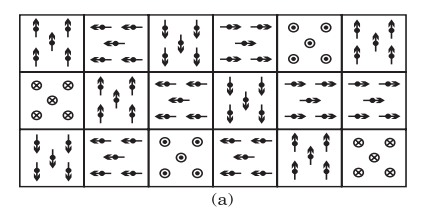
Explanation of Ferromagnetism : Like param-agnetic substance the atoms of ferromagnetic material also passess net magnetic moment and behave as a tiny magnetic dipole. The difference in paramagnetism and ferromagnetism is only that of intensify of magnetisation due to large magnetic moment in ferromagnetism substances. The atomic dipoles of ferromagnetic substance tend to align parallel to each other even in a weak magnetising field. The atomic dipoles are not independent of each other, in ferromagnetic substances but due to quantum mechanical mutual interaction the atoms in these substances form large number of small regions of size 10-4 cm to 1 cm containing 1017 to 1021 atomic dipoles. These regions are called domains. The atomic dipoles of one domain are aligned in the same direction but in different direction from the neighboring domain [Fig. (a)]. In this way each domain in the absence of any external magnetising field has net magnetic moment in a particular direction, but due to random orientation of different domains the resultant magnetic moment in the substance is zero. It is due to this fact that every piece of iron is not a magnet.
Image
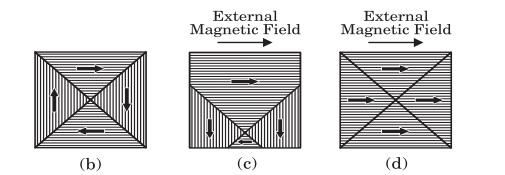
In Fig. (b) the probable directions of magnetic moment of four domains of a ferromagnetic substance are shown. When the ferromagnetic substance is placed in an external magnetising field the ferromagnetism can be increased in the following two ways :
Image
(i) By the displacement of the boundaries of the domains : When the external magnetising field is weak then the ferromagnetic substance is magnetised by this mechanism. In this mechanism the boundaries of the domains containing atomic magnetic dipoles oriented in the direction of external field increase in size, whereas those oriented in opposite direction to the field are reduced in size [Fig. (c)]. Here the ferromagnetic substance is magnetised strongly in the direction of external magn-etising field.
(ii) By the rotation of the domains : When the external magnetising field is strong then the ferromagnetic substance is magnetised by this mechanism. In this mechanism under the effect of strong magnetising field all the domains rotate until their magnetic momenta are aligned in the direction of external magnetic field [Fig. (d)]. Here the ferromagnetic substance is magnetised strongly in the direction of external magnetising field.

Need a full question paper?

Generate a complete, print-ready paper with questions like this in minutes — across 16+ boards, with answer keys.
Start Generating Free

Similar questions

What will be the total flux through the faces of the cube (Fig.) with side of length a if a charge q is placed at:
  1. A: a corner of the cube.
  2. B: mid-point of an edge of the cube.
  3. C: centre of a face of the cube.
  4. D: mid-point of B and C.
A proton projected in a magnetic field of $0.020T$ travels along a helical path of radius $5.0\ cm$ and pitch $20\ cm.$ Find the components of the velocity of the proton along and perpendicular to the magnetic field. Take the mass of the proton $= 1.6 \times 10^{-27}kg$
Assuming an electron is confined to a 1nm wide region , find the uncertainty in momentum using Heisenberg Uncertainty principle (Ref Eq 11.12 of NCERT Textbook). You can assume the uncertainty in position $\Delta\text{x}$ as 1nm. Assuming $\text{p}\Box\Delta\text{p}$, find the energy of the electron in electron volts.
Two long, straight wires, each carrying a current of $5A,$ are placed along the $X$ and $Y-$axes respectively. The currents point along the positive directions of the axes. Find the magnetic fields at the points $(a)\  (1m, 1m),\  (b) \ (-1m, 1m), \ (c) \ (-1m,-1m)$ and $(d) \ (1m, -1m),$
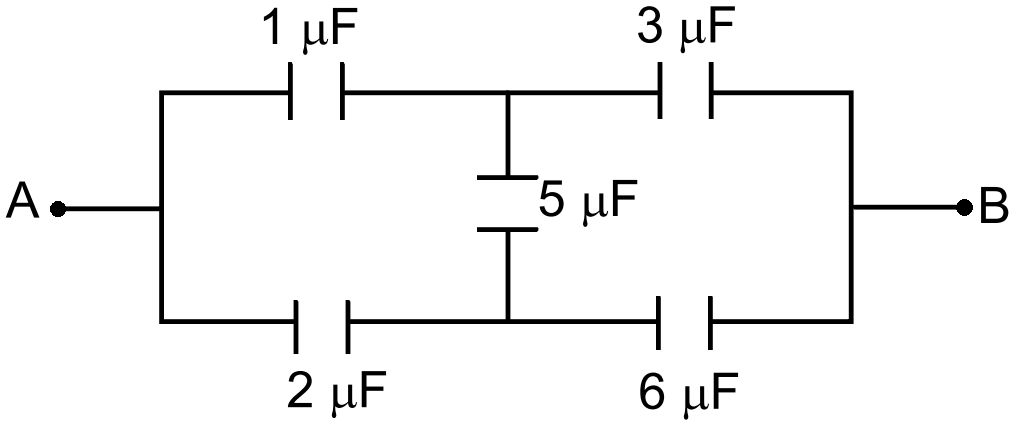
Convince yourself that parts (a), (b) and (c) of figure are identical. Find the capacitance between the points A and B of the assembly.


A parallel beam of light of wavelength $100\ nm$ passes through a sample of atomic hydrogen gas in ground state.
$(a)$ Assume that when a photon supplies some of its energy to a hydrogen atom, the rest of the energy appears as another photon. Neglecting the light emitted by the excited hydrogen atoms in the direction of the incident beam, what wavelengths may be observed in the transmitted beam?
$(b)$ A radiation detector is placed near the gas to detect radiation coming perpendicular to the incident beam. Find the wavelengths of radiation that may be detected by the detector.
A compound microscope consists of an objective lens of focal length $2.0 \ cm$ and an eyepiece of focal length $6.25 \ cm$ separated by a distance of $15 \ cm.$ How far from the objective should an object be placed in order to obtain the final image at $(a)$ the least distance of distinct vision $(25 \ cm),$ and $(b)$ at infinity? What is the magnifying power of the microscope in each case?
What are X-rays? If a X-ray tube is operated at V volt then prove that the minimum wavelength of X-rays emitted from the tube is given by: $\lambda_{min}=(12375/V)Å$
An aeroplane has to go from a point A to another point B, 500km away due 30° east of north. A wind is blowing due north at a speed of 20m/s. The air-speed of the
plane is 150m/s.
  1. Find the direction in which the pilot should head the plane to reach the point B.
  2. Find the time taken by the plane to go from A to B.
A copper wire having resistance $0.01$ ohm in each metre is used to wind a $400-$turn solenoid of radius $1.0\ cm$ and length $20\ cm$. Find the emf of a battery which when connected the solenoid will eauee a magnetic field of $1.0 \times 10^{-2}T$ near the centre of the solenoid.