Question
Define dispersion medium.

Answer

The term also refers to a substance in which another is colloidally dispersed. This is also known as a dispersing phase.
Colloids, also known as colloidal particles, are small particles found in solutions and suspensions. They can be mixed in such a way that they remain indefinitely dispersed. The resulting mixture is a colloidal dispersion, of which milk of magnesia is an example. It consists of solid magnesium hydroxide as the dispersed phase and water as the dispersion medium.
Need a full question paper?

Generate a complete, print-ready paper with questions like this in minutes — across 16+ boards, with answer keys.

Start Generating Free

Similar questions

State one property in which a solution of sugar in water resembles a mixture of sugar and sand, and one property in which it differs from it.
Which postulate of Dalton’s atomic theory is the result of law of conservation of mass given by Lavoisier?
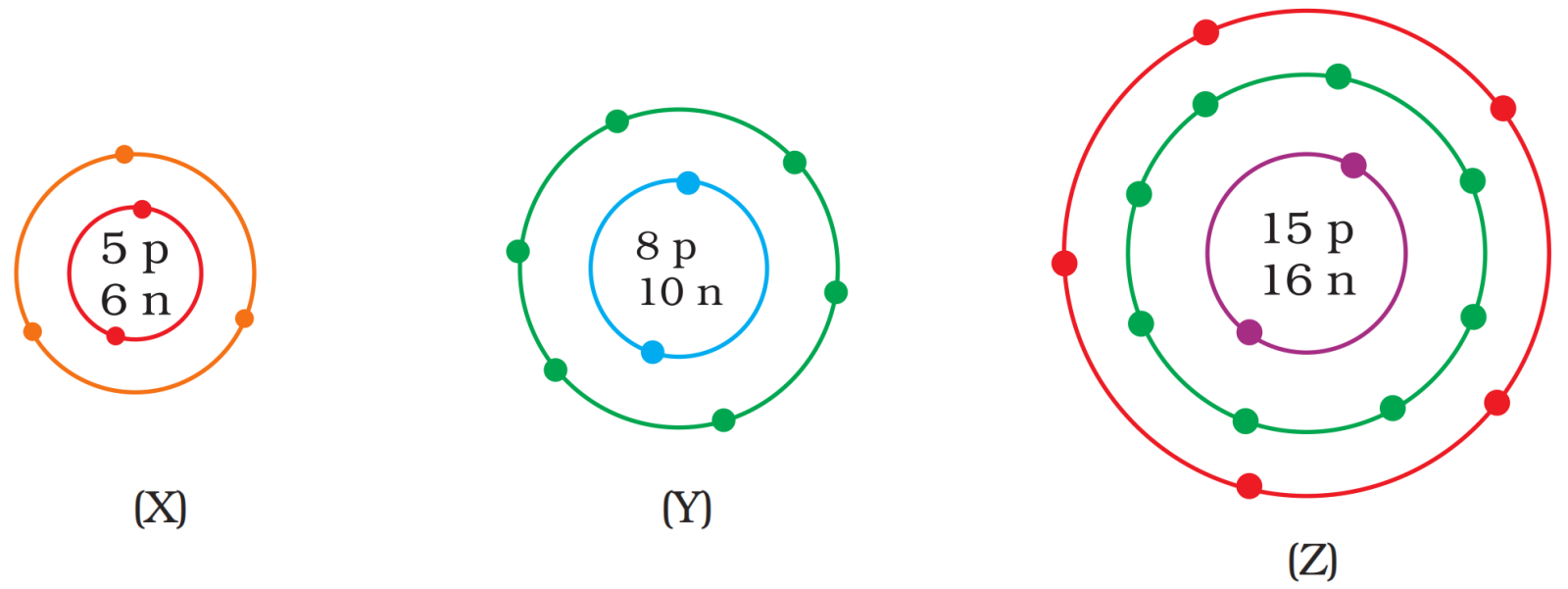
What information do you get from the Fig. about the atomic number, mass number and valency of atoms X, Y and Z? Give your answer in a tabular form.


If 100g of calcium carbonate on heating produces 44g of carbon dioxide, how much quick lime will be formed? Which law is followed for solving this problem?
What are the canal rays? State the nature of the constituents of canal rays. 
How will you differentiate between a suspension and a colloid?
Define ‘formula unit’ of an ionic compound. What is the formula unit of:
  1. Sodium chloride
  2. Magnesium chloride?
Complete the Table on the basis of information available in the symbols given below:
  1. $^{35}_{17}\text{Cl}$
  2. $^{12}_{6}\text{C}$
  3. $^{81}_{35}\text{Br}$
Elementnpnn
Calculate the concentration of a solution which contains 2.5g of salt dissolved in 50g of water.
When water is cooled to a temperature x, it gets converted into ice at temperature x by a process called P. And when ice at temperature x is warmed, it gets reconverted into water at the same temperature x in a process called Q.
  1. What is the value of temperature x in Kelvin?
  2. What is the process P known as?
  3. What is the name of energy released during process P?
  4. What is the process Q known as?
  5. What is the name of energy absorbed during process Q?