Question
Define eddy currents. How are they produced? In what sense are these currents undesirable in a transformer and how are these reduced in a device ?

Answer

Eddy Currents : In 1824 Gambey discovered that the oscillations of a magnet are rapidly damped if a copper sheet is placed under it and close to it. In 1895 Facault observed that when a metal piece is moved in a constant magnetic field or a varying magnetic field is subjected to the metal piece then the magnetic flux linked with the metal piece changes due to which induced current is generated in the whole volume of the piece. According to Lenz's law these currents oppose the change in magnetic flux. These currents look like eddies or whirlpool's in a fluid and are called eddy currents. These are also called Facault current after the name of their discoverer.
Image
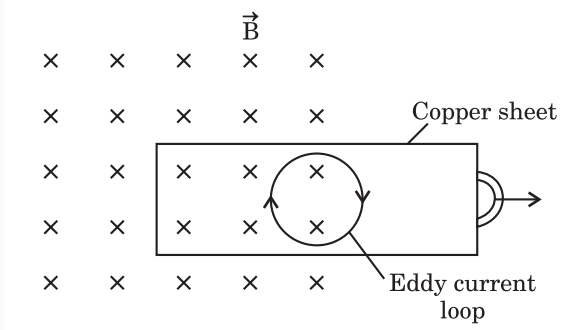
In adjoining figure, a copper sheet in the plane of the paper and a magnetic field is subjected is placed to it in the perpendicular direction to the plane of the paper directed inward represented by cross signs. If we withdraw the sheet out of the field, there is a decrease in its area A within the field and so the magnetic flux $(\Phi= BA )$ linked with the sheet also decreases. Because of this flux change, current loops are induced in the sheet coming out of the field and according to Lenz's law direction of currents is such that the magnetic field produced due to them is in the same direction as the original magnetic field. Thus, eddy currents oppose the decrease in magnetic flux i.e. the drawing out of the sheet. Similarly, if we insert the sheet into the magnetic field the eddy currents are generated in opposite direction to the previous one and oppose the entry of the sheet into the field.
Image
Eddy Currents undesirable in a device (transformer) and means of their reduction : Eddy currents produce a large amount of heat. This heating effect of eddy currents is undesirable in a number of cases like dynamos, transformers, etc. where the coil is wound on iron core. On the other hand, the heating effect of eddy currents is used to make induction furnaces. Similarly, the braking effect of eddy currents is also undesirable in a number of cases. On the other hand, the braking effect of eddy currents is used in electric brakes and ballistic galvanometers. Let us now see how the breaking and heating effects of eddy currents can be minimised.
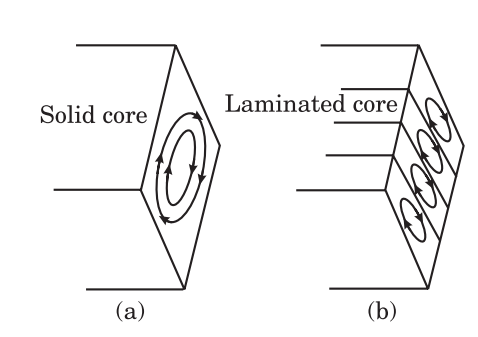
The solid iron core [Fig. (a)] is divided into a number of thin sheets as shown in Fig. (b). These thin sheets are electrically insulated from each other. Moreover, these sheets are so placed that the path of the induced eddy currents is broken by the insulating material between the sheets. In this way, the eddy currents are considerably reduced. Such cores are called laminated cores as used in transformer.

Need a full question paper?

Generate a complete, print-ready paper with questions like this in minutes — across 16+ boards, with answer keys.
Start Generating Free

Similar questions

A charged particle moving in a magnetic field experiences a force that is proportional to the strength of the magnetic field, the component of the velocity that is perpendicular to the magnetic field and the charge of the particle.

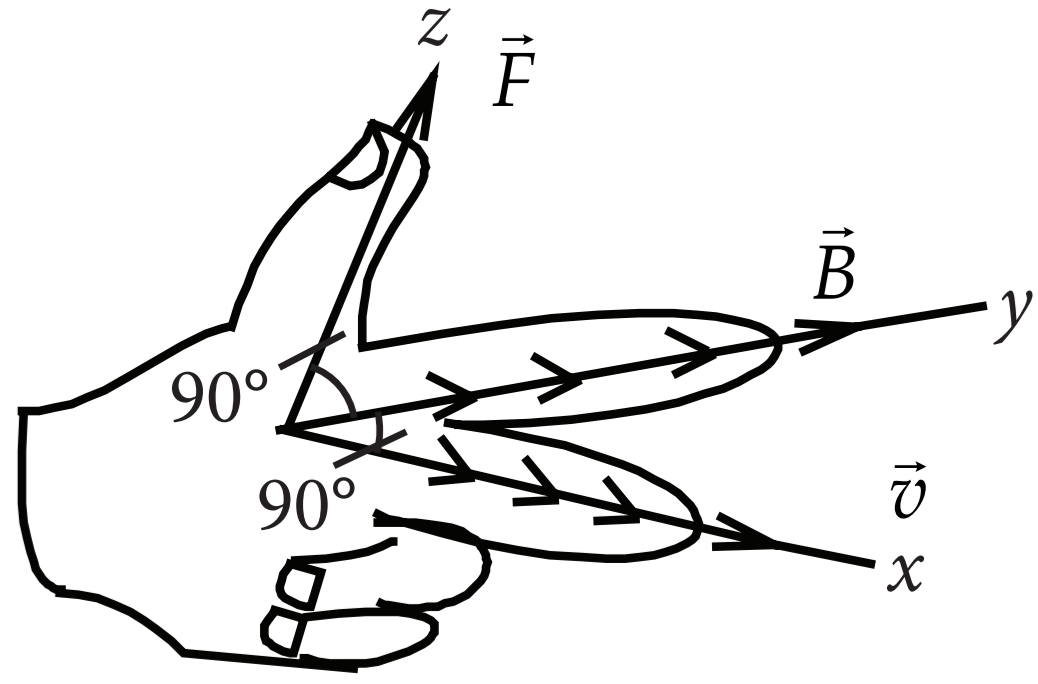
This force is given by $\vec{\text{F}}=\text{q}(\vec{\text{v}}\times\vec{\text{B}})$ where q is the electric charge of the particle, v is the instantaneous velocity of the particle, and Bis the magnetic field (in tesla).

The direction of force is determined by the rules of cross product of two vectors.

Force is perpendicular to both velocity and magnetic field. Its direction is same as $\vec{\text{v}}\times\vec{\text{B}}$ if q is positive and opposite of $\vec{\text{v}}\times\vec{\text{B}}$ if q is negative.

The force is always perpendicular to both the velocity of the particle and the magnetic field that created it. Because the magnetic force is always perpendicular to the motion, the magnetic field can do no work on an isolated charge. It can only do work indirectly, via the electric field generated by a changing magnetic field.

  1. When a magnetic field is applied on a stationary electron, it:
  1. Remains stationary.
  2. Spins about its own axis.
  3. Moves in the direction of the field.
  4. Moves perpendicular to the direction of the field.
  1. A proton is projected with a uniform velocity v along the axis of a current carrying solenoid, then,
  1. The proton will be accelerated along the axis.
  2. The proton path will be circular about the axis.
  3. The proton moves along helical path.
  4. The proton will continue to move with velocity v along the axis.
  1. A charged particle experiences magnetic force in the presence of magnetic field. Which of the following statement is correct?
  1. The particle is stationary and magnetic field is perpendicular.
  2. The particle is moving and magnetic field is perpendicular to the velocity.
  3. The particle is stationary and magnetic field is parallel.
  4. The particle is moving and magnetic field is parallel to velocity.
  1. A charge q moves with a velocity 2m s-1 along x-axis in a uniform magnetic field $\vec{\text{F}}=(\vec{\text{i}}+2\vec{\text{j}}+3\vec{\text{k}})\text{T,}$ charge will experience a force.
  1. In z-y plane.
  2. Along -y axis.
  3. Along +z axis.
  4. Along -z axis.
  1. Moving charge will produce.
  1. Electric field only.
  2. Magnetic field only.
  3. Both electric and magnetic field.
  4. None of these.
An electron emitted by a heated cathode and accelerated through a potential difference of 2.0 kV, enters a region with uniform magnetic field of 0.15 T. Determine the trajectory of the electron if the field,
  1. is transverse to its initial velocity,
  2. makes an angle of 30º with the initial velocity.
Professor C.V Raman surprised his students by suspending freely a tiny light ball in a transparent vacuum chamber by shining a laser beam on it. Which property of EM waves was he exhibiting? Give one more example of this property.
A moving-coil galvanometer has a 50-turn coil of size 2cm × 2cm. It is suspended between the magnetic poles producing a magnetic field of 0.5T. Find the torque on the coil due to the magnetic field when a current of 20mA passes through it. 
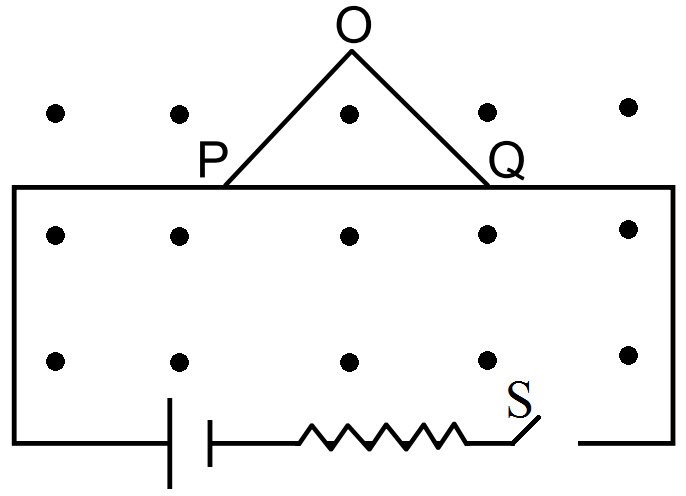
Shows a rod PQ of length 20.0cm and mass 200g suspended through a fixed point O by two threads of lengths 20.0cm each. A magnetic field of strength 0.500T exists in the vicinity of the wire PQ, as shown in the figure. The wires connecting PQ with the battery are loose and exert no force on PQ.
  1. Find the tension in the threads when the switch S is open.
  2. A current of 2.0A is established when the switch S is closed. Find the tension in the threads now.

A solenoid 60 cm long and of radius 4.0 cm has 3 layers of windings of 300 turns each. A 2.0 cm long wire of mass 2.5 g lies inside the solenoid (near its centre) normal to its axis; both the wire and the axis of the solenoid are in the horizontal plane. The wire is connected through two leads parallel to the axis of the solenoid to an external battery which supplies a current of 6.0 A in the wire. What value of current (with appropriate sense of circulation) in the windings of the solenoid can support the weight of the wire? g = 9.8 m s–2.
The charge enclosed by a spherical Gaussian surface is $8.85 \times 10^{-8}$ Coulomb. Calculate (a) the electric flux emerging out of the Gaussian surface, (b) what will be the change in electric flux if the radius of the Gaussian surface is doubled?
An electric dipole of length 2 cm is placed in an electric field of intensity $10^5$ Newton/Coulomb in such a way that its axis makes an angle of $30^{\circ}$ with the direction of the field. A torque of $10 \sqrt{3}$ Newton meter acts on it. Find the magnitude of charge on the electric diple.
Currents can be induced not only in conducting coils, but also in conducting sheets or blocks. Current is induced in solid metallic masses when the magnetic flux threading through them changes. Such currents flow in the from of irregularly shaped loops throughout the body of the metal. These currents look like eddies or whirlpools in water so they are known as eddy currents. Eddy currents have both undesirable effects and practically useful applications. For example it causes unnecessary heating and wastage of power in electric motors, dynamos and in the cores of transformers.
  1. The working of speedometers of trains is based on:
  1. Wattless currents.
  2. Eddy currents.
  3. alternating currents.
  4. pulsating currents.
  1. Identify the wrong statement.
  1. Eddy currents are produced in a steady magnetic field.
  2. Induction furnace uses eddy currents to produce heat.
  3. Eddy currents can be used to produce braking force in moving trains.
  4. Power meters work on the principle of eddy currents.
  1. Which of the following is the best method to reduce eddy currents?
  1. Laminating core.
  2. Using thick wires.
  3. By reducing hysteresis loss.
  4. None of these.
  1. The direction of eddy currents is given by:
  1. Fleming's left hand rule.
  2. Biot-Savart law.
  3. Lenz's law
  4. Ampere-circuital law.
  1. Eddy currents can be used to heat localised tissues of the human body. This branch of medical therapy is called:
  1. Hyperthermia.
  2. Diathermy.
  3. Inductothermy.
  4. None of these.
(a) What will be the charge on $12.5 \times 10^8$ electrons?(b) Which is larger between 1 Coulomb charge and 1 electron charge? How many electronic charges will there be in one Coulomb charge?