Question
Define electric field intensity and equipotential surface in current carrying conductor.

Answer

Electric Field Intensity : In a current carrying conductor the ratio of potential difference applied across the ends of the conductor and the length of the conductor is equal to the electric field intensity at any point in the conductor. i.e.
$ E = V/l $
where $ V = $ potential difference and $ l = $ length.
Equipotential Surface : In a currnet carrying conductor electric currnet flows from the end of higher potential towards the end of lower potential. Hence electric potential decreases with increase the distance from the end of higher potential toward the end of lower potential but the electric potential at all points lying on any cross-section of the conductor is the same. Hence any cross-section of the conductor is equipotential surface.

Need a full question paper?

Generate a complete, print-ready paper with questions like this in minutes — across 16+ boards, with answer keys.
Start Generating Free

Similar questions

X-ray and visible light travel at the same speed in vacuum. Do they travel at the same speed in glass?
A bullet going with speed $350m/s$ enters a concrete wall and penetrates a distance of $5.0\ cm$ before coming to rest. Find the deceleration.
Unit of magnetic flux is weber. State its equivalent electric unit
If a constant potential difference is applied across a bulb, the current slightly decreases as time passes and then becomes constant. Explain.
The torque on a current loop is zero if the angle between the positive normal and the magnetic field is either $\theta=0^\circ$ or $\theta=180^\circ$ In which of the two orientations, the equilibrium is stable?
Using Bohr’s atomic model, derive the expression for the radius of $n^{th}$ orbit of the revolving electron in a hydrogen atom.
The dielectric strength of air is $3.0 \times 10^6\ V/m.$ A parallel$-$plate air$-$capacitor has area $20\ cm^2$ and plate separation $0.10\ mm.$ Find the maximum rms voltage of an $AC$ source that can be safely connected to this capacitor.
Two towers on top of two hills are $40 \ km$ apart. The line joining them passes $50 m$ above a hill halfway between the towers. What is the longest wavelength of radio waves, which can be sent between the towers without appreciable diffraction effects?
The ground state energy of hydrogen atom is –13.6 eV. What are the kinetic and potential energies of the electron in this state?
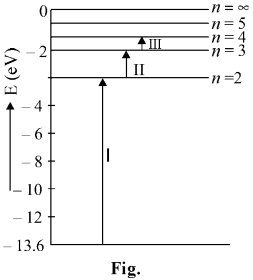
The photons of continuous frequency range are passing through rarafied hydrogen pattern. Three absorbed lines are shown in Fig.
Image
(i) To which series of hydrogen spectrum, these lines are related?
(ii) Out of them which has maximum wavelength?