Question
Define electric field intensity. Write its SI unit. Write the magnitude and direction of electric field intensity due to an electric dipole of length 2a at the midpoint of the line joining the two charges.

Answer

Electric Field Intensity: The electric field intensity at any point in an electric field is defined as the electric force per unit positive test charge placed at that point i.e.,

$\vec{\text{E}}=\lim\limits_{\text{q}_0\rightarrow0}\frac{\vec{\text{F}}}{\text{q}_0}$

The test charge q0 has to be vanishingly small so that it does not affect the electric field of the main charge.

The SI unit of electric field intensity is newton/ coulomb.

Electric Field Strength at mid-point of dipole: The electric field strength at mid-point C due to charge +q is -q along the same direction.

E = E1 + E2

$=\frac{1}{4\pi\in_0}\frac{\text{q}}{\text{a}^2}+\frac{1}{4\pi\in_0}\frac{\text{q}}{\text{a}^2}=\frac{1}{4\pi\in_0}\frac{2\text{q}}{\text{a}^2}$

Its direction is from +q to -q.

Need a full question paper?

Generate a complete, print-ready paper with questions like this in minutes — across 16+ boards, with answer keys.

Start Generating Free

Similar questions

A candle flame 1.6cm high is imaged in a ball bearing of diameter 0.4cm. If the ball bearing is 20cm away from the flame, find the location and the height of the image.
Two bodies make an elastic head-on collision on a smooth horizontal table kept in a car. Do you expect a change in the result if the car is accelerated on a horizontal road because of the noninertial character of the frame? Does the equation "Velocity of separation = Velocity of approach" remain valid in an accelerating car? Does the equation "Final momentum = Initial momentum" remain valid in the accelerating car?
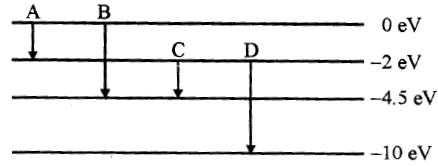
The energy levels of an atom are as shown below:

  1. Which of them will result in the transition of a photon of wavelength 275 nm?

  1. Which transition corresponds to emission of radiation of maximum wavelength?
Potential at an instant $t$ in an ac circuit is $E=200 \sin 157 t . \cos 157 t$ volts and current is $I=\sin \left(314 t+\frac{\pi}{3}\right) \quad$ Amperes. In this condition calculate :
(a) frequency
(b) root mean square value of voltage
(c) impedance of the circuit
(d) power factor.
Explain barrier potential of $p-n$ junction.
Characteristic X-rays may be used to identify the element from which they are being emitted. Can continuous X-rays be used for this purpose?
Write two properties and two uses of X-rays.
Write and explain principle of superposition for stationary electric forces.
Two particles have equal masses of 5.0g each and opposite charges of +4.0 × 10-5 C and -4.0 × 10-5C. They are released from rest with a separation of 1.0m between them. Find the speeds of the particles when the separation is reduced to 50cm.
Repeat the previous exercise if the angle between each pair of springs is 120° initially.