Question
Define electric flux. Write its SI unit.
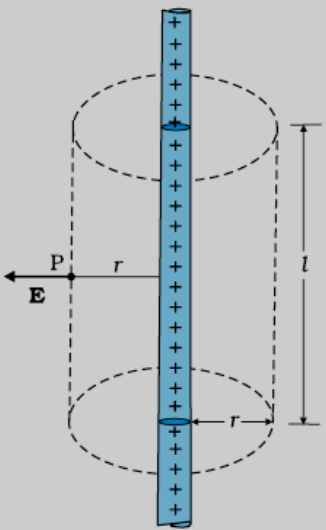
Using Gauss’s law, deduce an expression for electric field intensity due to an infinitely long straight uniformly charged wire.
Answer

The electric flux is defined as

$\phi_E=\overrightarrow{E}.\overrightarrow{A}={EA}\cos\theta$

Its S.I unit is $(Nm^{2}C^{-1})$

The Gaussian surface is cylindrical and field is radial. At the cylindrical part of the surface, cylindrical part of the surface, $ \overrightarrow{E}$ is normal to the surface at every point and its magnitude is constant (since it depends only on r). By Gauss’s theorem : $ \oint \overrightarrow{E}.{d}\overrightarrow{S}=\frac{q}{\in_0}$

$\therefore(2\pi{rl})=\frac{\lambda{l}}{\in_0}$ 

$\text{or}\text{ }\text{ } E=\frac{\lambda}{2\pi\in_0r}$

Need a full question paper?

Generate a complete, print-ready paper with questions like this in minutes — across 16+ boards, with answer keys.

Start Generating Free

Similar questions

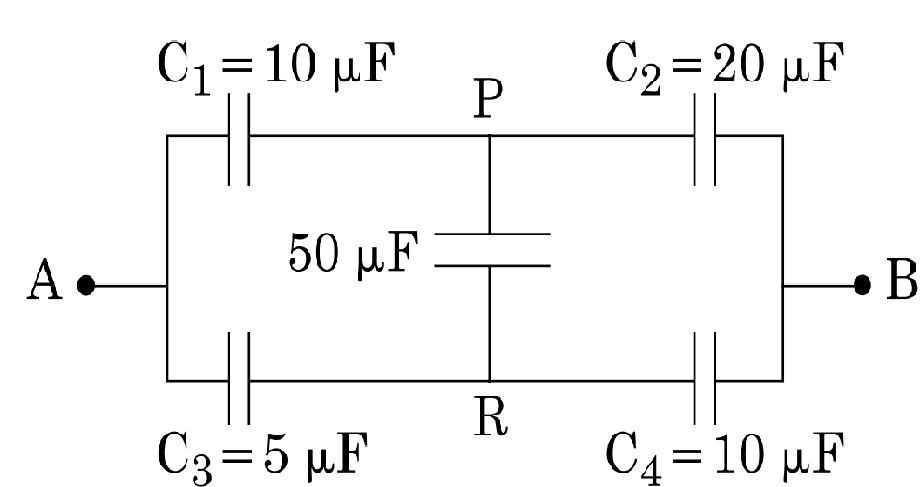
Calculate the equivalent capacitance between points A and B in the circuit below. If a battery of 10 V is connected across A and B, calculate the charge drawn from the battery by the circuit.

A coil of cross-sectional area A lies in a uniform magnetic field B with its plane perpendicular to the field. In this position the normal to the coil makes an angle of 0° with the field. The coil rotates at a uniform rate to complete one rotation in time T. Find the average induced emf in the coil during the interval when the coil rotates:
i. from $0^{\circ}$ to $90^{\circ}$ position
ii. from $90^{\circ}$ to $180^{\circ}$ position
iii. from $180^{\circ}$ to $270^{\circ}$ and
iv. from $270^{\circ}$ to $360^{\circ}$
i. Using Bohr's second postulate of quantisation of orbital angular momentum show that the circumference of the electron in the nth orbital state in hydrogen atom is n-times the de-Broglie wavelength associated with it.
ii. The electron in hydrogen atom is initially in the third excited state. What is the maximum number of spectral lines which can be emitted when it finally moves to the ground state?
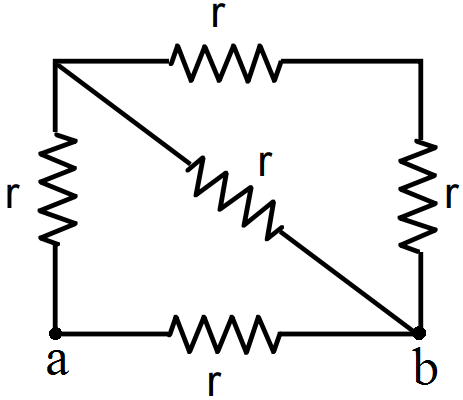
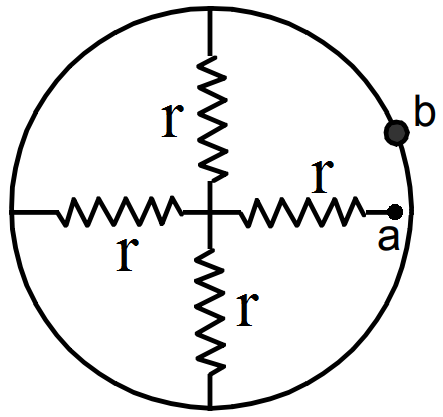
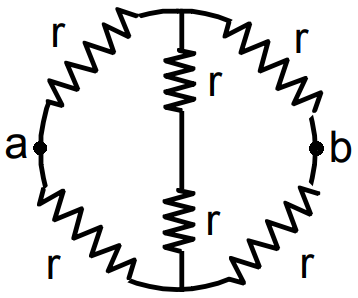
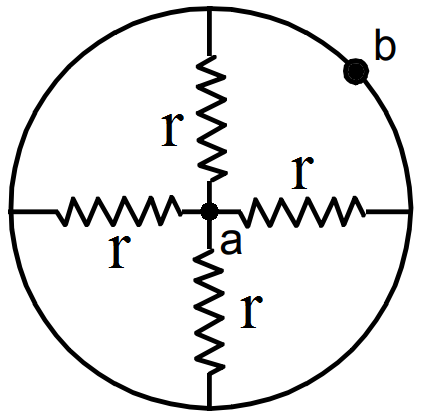
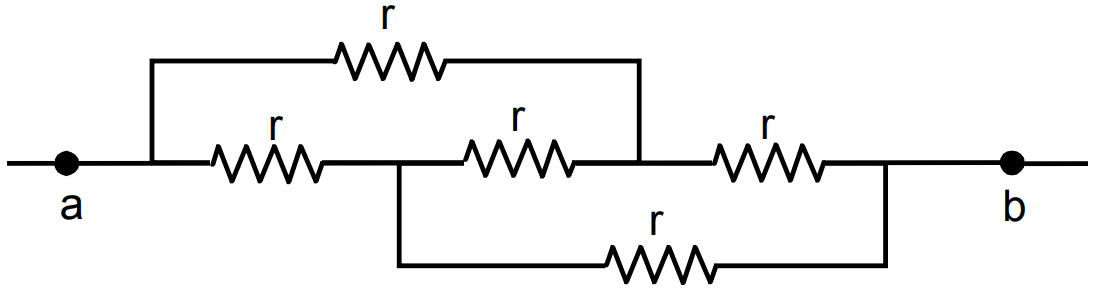
Find the equivalent resistances of the networks shown in the figure. between the points a and b.

  1.  

  1.  

  1.  

  1.  

  1.  

Deuteron is a bound state of a neutron and a proton with a binding energy $B =2.2 MeV$. A $\gamma$-ray of energy E is aimed at a deuteron nucleus to try to break it into a (neutron + proton) such that the n and p move in the direction of the incident $\gamma$-ray. If $E = B$, show that this cannot happen. Hence calculate how much bigger than B must E be for such a process to happen.
A point object is placed on the principal axis of a convex lens (f = 15cm) at a distance of 30cm from it. A glass plate $(\mu=1.50)$ of thickness 1cm is placed on the other side of the lens perpendicular to the axis. Locate the image of the point object.
A long straight wire in the horizontal plane carries a current of 50 A in north to south direction. Give the magnitude and direction B at a point 2.5 m east of the wire.
a. A toroidal solenoid with an air core has an average radius of 0.15 m , area of cross section $12 \times 10^{-4} m^2$ and 1200 turns. Obtain the self inductance of the toroid. Ignore field variation across the cross section of the toroid.
b. A second coil of 300 turns is wound closely on the toroid above. If the current in the primary coil is increased from zero to 2.0 A in 0.05 s, obtain the induced emf in the secondary coil.
What is the parallel and crossed arrangement of polaroid?
A thin prism of crown glass $(\mu_\text{r}=1.515,\mu_\text{v}=1.525)$ and a thin prism of flint glass $(\mu_\text{r}=1.612,\mu_\text{v}=1.632)$ are placed in contact with each other. Their refracting angles are 5.0° each and are similarly directed. Calculate the angular dispersion produced by the combination.