Genetic Engineering : Through this technique, by changing the chemistry of genetic material (DNA or RNA) and introducing it into the host organisms, its phenotype is changed.
Following are the main steps of genetic engineering :
(1) Identification and isolation of the desired gene or target gene : The selection of any gene depends on its usefulness. The aim of scientists is to use the genes of microorganisms to synthesize hormones necessary for humans, to diagnose diseases, to increase the production of essential enzymes, vitamins, antibiotics, to produce such microorganisms that can protect useful plants from the effects of herbicides and pesticides. This could include increasing the efficiency of photosynthesis of higher grade plants, developing the ability to fix nitrogen in plants other than the Leguminosae family, increasing crop yield and nutritional value, etc. Therefore, the selection of desired DNA depends on the purpose.
Desired DNA there are three types : (i) Genomic DNA (ii) C-DNA (iii) Synthetic DNA.
The work of identifying and isolating the desired gene for cloning is done by restriction enzymes.
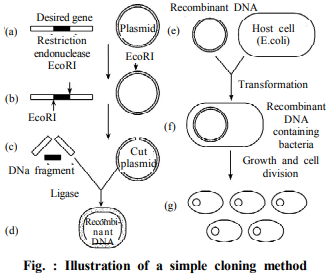 (2) Construction of Recombinant DNA (r.DNA) or Chimeric DNA :
 In this step, the desired gene isolated is combined with the vector DNA. This process is catalyzed by an enzyme called DNA ligase. This enzyme is synthesized in every cell. Recombinant DNA is formed by adding the desired gene to the carrier DNA.
(3) Transfer of recombinant DNA into the host cell or receptor cell : Entry of recombinant DNA into the bacterial cell is done by transformation process. For this, the recombinant DNA is transferred to a hot solution of 37- 43°C along with the bacterial cells and they are given a heat shock due to which the r-DNA enters the bacterial cell. Eukaryotic genes use yeast cells and yeast plasmids as vectors for gene transfer. Ti and Ri plasmids of Agrobacterium are used for gene transfer into plant cells. Transfer of regenerative DNA into cells in culture medium is done by transfection.
(4) Selection and multiplication of host cells containing recombinant DNA : To know the success of the inserted gene, genes providing resistance to antibiotics are generally used as marker genes. These can be genes resistant to antibiotics like ampicillin, tetracycline, kanamycin etc. The cells in which the presence of cloned gene is to be tested are cultured in a medium containing the above mentioned antibiotics. For example, if a gene resistant to ampicillin has been used as a marker and cells containing recombinant DNA grow in ampicillin medium, it means that the cloned gene was inserted at the correct location. On the contrary, if cells do not grow in this medium, then surely the cloned gene in the recombinant DNA has not been inserted at the right place.
Selected bacterial cells are cultured on solid medium. Where colonies of bacteria containing the plasmid are formed, along with the growth of the bacterial cell, the number of desired genes also increases. This process is called cloning.
(5) Expression into the recipient cell of the desired gene from the selected clones : Selected recombinant cells and vectors are isolated and used as per the desired purpose. These are cultured to synthesize the desired protein. As per requirement, these genes are transferred into bacteria, yeast, plants and animals through various mediums. In this way, by transferring the desired genes to other organisms, these organisms are prepared to perform the desired work. For example, if pathogen resistant genes are inserted into a plant, the plant becomes resistant to disease.