Question
Define gravitational potential and gravitational field intensity. Give their units. Also write the relation between them.

Answer

Gravitational potential at a point in gravitational field of the body is defined as the amount of work done in bringing a body of unit mass from infinity to that point without acceleration. It has units of J/ kg. Gravitational field intensity is defined as the force experienced by a body of unit mass placed at that point provided the presence of unit mass does not disturb the original gravitational field. It is expressed in N/ kg. $\text{I}=\frac{\text{V}_{\text{p}}}{\text{r}}$

Need a full question paper?

Generate a complete, print-ready paper with questions like this in minutes — across 16+ boards, with answer keys.
Start Generating Free

Similar questions

Two trains, each having a speed of $30 km / h$, are headed towards each other on the same track. A bird that can fly $60 km / h$ flies off the front of one train when they were 60 km apart and heads directly to the other train. On reaching the train, the bird flies back to the first train. What is the total distance the bird travels before the trains collide?
State three basic laws of motion. Show that the first law of motion gives the definition of force and the second law of motion gives the measure of force.
A particle of mass $0.1kg$ is held between two rigid supports by two springs of force constants $8N/ m$ and $2N/ m$. If the particle is displaced along the direction of the length of the springs, calculate its frequency of vibration.
What are the conditions so that transfer of kinetic energy is maximum during a collision?
The radius of the Earth is $6.37 × 10⁶m$ and its average density is $5.517 \times 10^3kg m^{-3}$. Calculate the mass of earth to correct significant figures.
In one-dimensional motion the velocity of a particle depends on time in the following manner :
$
v=(5 t+7) m / s
$
If the particle is at the origin at $t=0$, then what will be the position of the particle at $t=2 sec$ ?
In the expression $P = El^2 m^{-5} G^{-2}, E, m, l$ and $G$ denote energy, mass, angular momentum and gravitational constant, respectively. Show that $P$ is a dimensionless quantity.
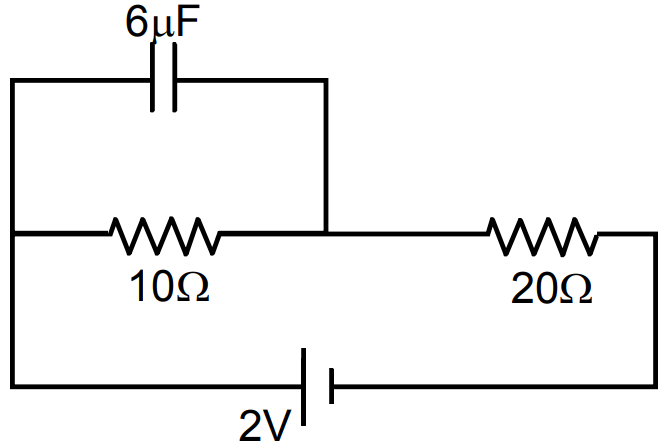
Find the charge on the capacitor shown in figure.
$i.$ Explain clearly with examples the distinction between magnitude of displacement over an interval of time and the total length of the path covered by a particle over the same interval.
$ii.$ A body starting from rest accelerates uniformly along a straight line at the rate of $10\  ms^{-2}$ for $5 s$ . It moves for $2 s$ with uniform velocity of $50\  ms^{-1}$. Then it retards uniformly and comes to rest in $3 s$ . Draw velocity$-$time graph of the body and find the total distance travelled by it.
In dealing with motion of projectile in air, we ignore effect of air resistance on motion. This gives trajectory as a parabola as you have studied. What would the trajectory look like if air resistance is included? Sketch such a trajectory and explain why you have drawn it that way.