Question
Define gravitational potential. Derive the formulas of gravitional potential due to a solid sphere of mass M and radius R at points located on its outer surface and inside.

Answer

self

Need a full question paper?

Generate a complete, print-ready paper with questions like this in minutes — across 16+ boards, with answer keys.
Start Generating Free

Similar questions

A spherical ball of mass m and radius r rolls without slipping on a rough concave surface of large radius R. It makes small oscillations about the lowest point, Find the time period.
A steel tape $1m$ long is correctly calibrated for a temperature of $27.0°C$. The length of a steel rod measured by this tape is found to be $63.0cm$ on a hot day when the temperature is $450°C$. What is the actual length of the steel rod on that day? What is the length of the same steel rod on a day when the temperatures $27.0°C$? Coefficient of linear expansion of steel = $1.20 \times 10^{–5} K^{–1}$.
An air chamber of volume $V$ has a neck of the area of cross-section $A$ into which a ball of mass $m$ can move without friction. Show that when the ball is pressed down through some distance and released, the ball executes SHM. Obtain the formula for the time period of this SHM, assuming pressure-volume variations of the air to be
i. isothermal and
ii. adiabatic.
Consider that an ideal gas ( $n$ moles) is expanding in a process given by $P=f(V)$, which passes through a point $\left(V_0\right.$ $\left.P_0\right)$. Show that the gas is absorbing heat at $\left(P_0, V_0\right)$ if the slope of the curve $P=f(V)$ is larger than the slope of the adiabat passing through $\left(\mathrm{P}_0, \mathrm{~V}_0\right)$.
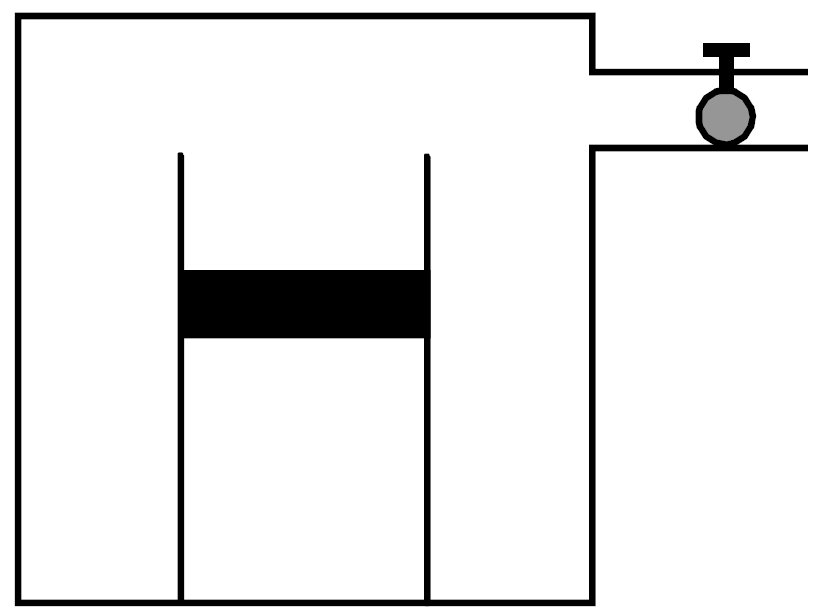
An ideal gas is kept in a long cylindrical vessel fitted with a frictionless piston of cross-sectional area $10cm^2$ and weight $1kg$ (figure.) The vessel itself is kept in a big chamber containing air at atmospheric pressure $100kPa$. The length of the gas column is $20cm$. If the chamber is now completely evacuated by an exhaust pump, what will be the length of the gas column? Assume the temperature to remain constant throughout the process.
A circular disc made of iron is rotated about its axis at a constant velocity to $\omega$. Calculate the percentage change in the linear speed of a particle of the rim as the disc is slowly heated from $20^{\circ} \mathrm{C}$ to $50^{\circ} \mathrm{C}$ keeping the angular velocity constant. Coefficient of linear expansion of iron $=1.2 \times 10^{-5}{ }^{\circ} \mathrm{C}^{-1}$.
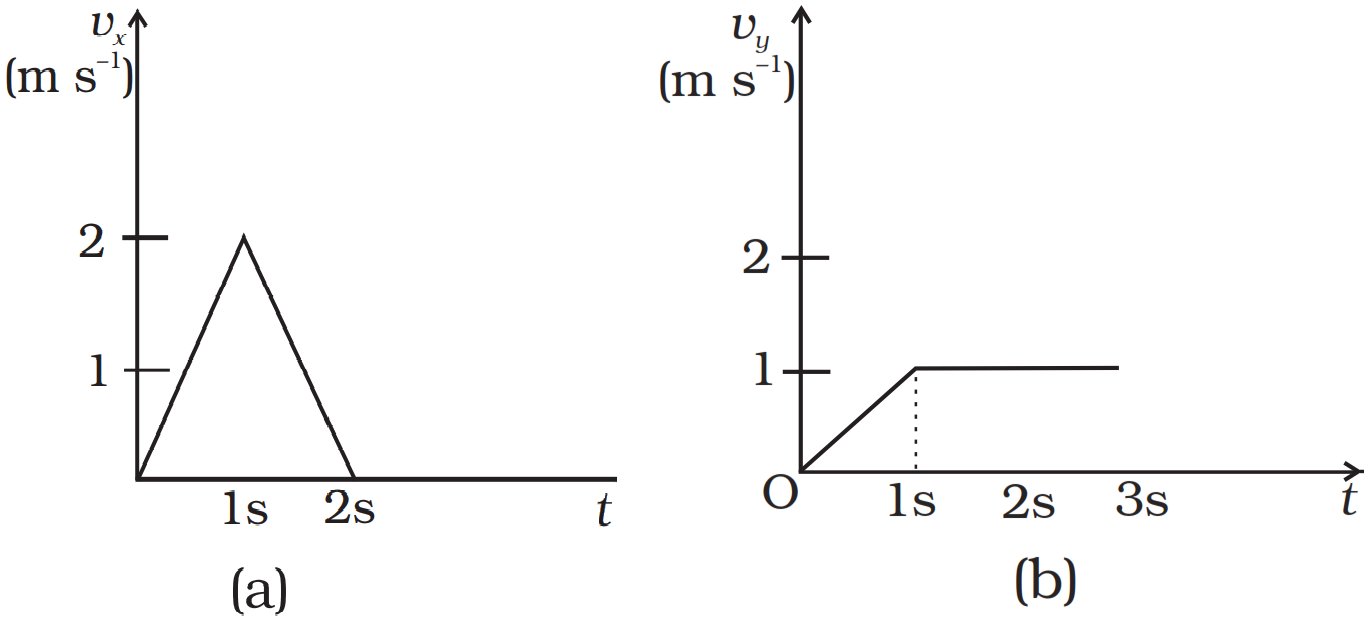
$(v_{x,} t)$, and $(v_{y,} t )$ diagrams for a body of unit mass. Find the force as a function of time.
A ball is kept at a height h above the surface of a heavy transparent sphere made of a material of refractive index $\mu.$ The radius of the sphere is R. At t = 0, the ball is dropped to fall normally on the sphere. Find the speed of the image formed as a function of time for $\text{t}<\sqrt{\frac{2\text{h}}{\text{g}}}.$ Consider only the image by a single refraction.
A capacitor of capacitance C is connected to a battery of emf $\in$ at t = 0 through a resistance R. Find the maximum rate at which energy is stored in the capacitor. When does the rate have this maximum value?
Prove that the velocity v of translation of a rolling body (like a ring, disc, cylinder or sphere) at the bottom of an inclined plane of height h is given by:$\text{v}^2=\frac{2\text{gh}}{\big(1+\frac{\text{K}^2}{\text{R}^2}\big)}$
Note K is the radius of gyration of the body about its symmetry axis, and R is the radius of the body. The body starts from rest at the top of the plane.