Question
Define hydrogen bond. Is it weaker or stronger than the van der Waals forces?

Answer


A hydrogen bond is defined as an attractive force acting between the hydrogen attached to an electronegative atom of one molecule and an electronegative atom of a different molecule (may be of the same kind).
Due to a difference between electronegativities, the bond pair between hydrogen and the electronegative atom gets drifted far away from the hydrogen atom. As a result, a hydrogen atom becomes electropositive with respect to the other atom and acquires a positive charge. a positive charge.
$4^\delta-\text{X}^{\delta-}.......\text{H}^{\delta+}-\text{X}^{\delta-}.......\text{H}^{\delta+}-\text{X}^\delta$
The magnitude of H-bonding is maximum in the solid state and minimum in the gaseous state.
There are two types of H-bonds:
  1. Intermolecular H-bond e.g., $\mathrm{HF}, \mathrm{H}_2 \mathrm{O}$ etc.
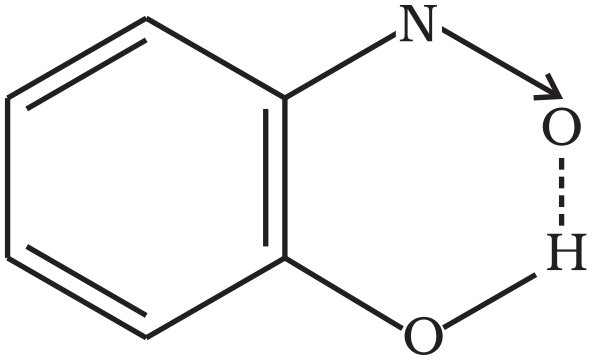
  2. Intramolecular H-bond e.g., o-nitrophenol.
  1. Hydrogen bonds are stronger than Van der Walls forces since hydrogen bonds are regarded as an extreme form of dipole-dipole interaction.

Need a full question paper?

Generate a complete, print-ready paper with questions like this in minutes — across 16+ boards, with answer keys.
Start Generating Free

Similar questions

1. Write all structural isomers of molecular formula $C _3 H _6 O$
2. Write resonance structures of $CH _3 COO ^{-}$and show the movement of electrons by curved arrows.
On the basis of Le Chatelier principle explain how temperature and pressure can be adjusted to increase the yield of ammonia in the following reaction:
$
\begin{aligned}
& N_2(g)+3 H_2(g) \rightleftharpoons 2 NH_3(g) \\
& \Delta H=-92.38 kJmol^{-1}
\end{aligned}
$
What will be the effect of the addition of argon to the above reaction mixture at constant volume?
i. Explain:
1. $\mathrm{CCl}_4$ doesn't hydrolyse unlike $\mathrm{SiCl}_4$.
2. Ga has a lower atomic radius compared to Al.
ii. Write balanced equations for:
a. Silicon dioxide is treated with hydrogen fluoride.
b. Boric acid is added to water.
iii. Diborane reacts with $\mathrm{NH}_3$ followed by heating.
Boron fluoride exists as $\mathrm{BF}_3$ but boron hydride doesn't exist as $\mathrm{BH}_3$. Give reason. In which form does it exist? Explain its structure.
Explain the effect of temperature on spontaneity.
Calculate the energy required for the process,
$\text{He}^+(\text{g})\rightarrow\text{He}^{2+}\text{(g)}+\text{e}^-$
The ionization energy for the H atom in the ground state is $2.18 \times 10^{-18} \mathrm{~J}$ atom $^{-1}$
At 1127 K and 1 atmosphere pressure, a gaseous mixture of CO and $CO _2$ in equilibrium with solid carbon has 90.55\% CO by mass.
$
C(s)+CO_2(g) \rightleftharpoons 2 CO(g)
$
Calculate $K _{ C }$ for the reaction at the above temperature.
A sample of $0.50 g$ of an organic compound was treated according to Kjeldahl's method. The ammonia evolved was absorbed in $50 ml$ of $0.5 \mathrm{M} \mathrm{H}_2 \mathrm{SO}_4$. The residual acid required $60 mL$ of $0.5 M$ solution of NaOH for neutralisation. Find the percentage composition of nitrogen in the compound.
Derive the formula to find the ionization constant of weak acids and bases and how will you obtain the value of [H] to find their pH?
Explain the second and third law of thermodynamics.