Question
Define ionisation enthalpy. Discuss the factors affecting ionisation enthalpy of the elements and its trends in the periodic table.

Answer

 Ionization energy is defined as the energy required to remove an electron from the outermost shell of an isolated gaseous atom. Ionization energy depends on the following factors:

  1. Atomic radius: Smaller the atomic radius, the higher is the atomic energy. This is because the Coulombic attractive forces on the negatively charged valence electrons by the positively charged nucleus is much higher in the case of smaller atom-the force of attraction decreases with the increase in atomic radius, i.e separation between the electrons and the nucleus in accordance with the inverse square law.

  2. Nuclear charge: the higher the positive charge of the nucleus, stronger is it's attraction for the electrons, and hence the harder it is to remove the electrons.

  3. Orbital penetration: It's easier to remove electrons from p orbitals than from s orbitals, because the s orbitals penetrate towards the nucleus more closely than the p orbitals, thus making the electrons in the s orbital feel greater nuclear attraction.

  4. Electron pairing: within a subshell, paired electrons are easier to remove than unpaired ones. This is because repulsion between electrons in the same orbital is higher than repulsion between electrons in different orbitals.

  5. Shielding or screening effect of the inner orbitals: Due to the electrons present in the inner orbitals, the electrons in the outermost orbitals feel lesser attraction for the nucleus than expected. In other words, the inner electron orbitals effectively screen or shield the outermost electrons from the nucleus, due to which the ionization energy decreases. 

Need a full question paper?

Generate a complete, print-ready paper with questions like this in minutes — across 16+ boards, with answer keys.
Start Generating Free

Similar questions

  1. Calculate the kinetic energy of an electron in second Bohr orbit of hydrogen atom. [a0 is Bohr radius].
  2. Out of the d-orbials which does not have four lobes?
  3. What is physical significance of $\Psi^2?$
1. What are electrophiles and nucleophiles? Explain with examples.
2. Derive the structure of 3 - Nitrocyclohexene.
How do atomic radius vary in a period and in a group? How do you explain the variation?
Attempt any five of the following:
1. Why are Alkenes called olefins?
2. Convert 1-bromopropane to 2-bromopropane.
3. If Qc < Kc, when we continuously remove the product, what would be the direction of the reaction?
4. Convert methane into ethane.
5. What are cycloalkanes?
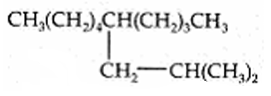
6. Write IUPAC name of following:
Image
7. How will you convert ethanoic acid into ethene?
0.2325g of an organic compound was analysed for nitrogen by Duma's method 0.0317L of moist nitrogen was collected at 25°C and 755.8mm pressure. Calculate the percentage of nitrogen. [Aq. tension of water at 25°C is 23.8mm Hg.)
Calculate the degree of ionization of 0.05 M acetic acid if its $pK _{ a }$ value is 4.74 . How is the degree of dissociation affected when its solution also contains
a. 0.01 M
b. 0.1 M HCl ?
1. Describe the effect of
a. addition of $H _2$
b. addition of $CH _3 OH$
c. removal of CO
d. removal of $CH _3 OH$ on the equilibrium of the reaction,
$
2 H_2(g)+CO(g) \rightleftharpoons CH_3 OH(g)
$
2. What happens to an equilibrium in a reversible reaction if a catalyst is added to it?
Explain the molecular orbital diagram of benzene.
On the basis of VSEPR theory, compare the geometries of molecules of types $AB _2 E , AB _3 E$, $AB _2 E _2, AB _4 E , AB _3 E _2, AB _5 E$ and $AB _4 E _2$ with various examples. (Here $E =$ lone electron pair)