Question
Define ionization enthalpy. Name the factors on which ionisation enthalpy depends? How does it vary down the group and across a period?
Answer

i. The energy required to remove an electron from the isolated gaseous atom in its ground state is called ionization enthalpy $(\triangle _iH).$
Ionization enthalpy is the quantitative measure of tendency of an element to lose electron and expressed in $kJ\ mol^{-1}.$
ii. Ionization energy depends on the following factors
  • Size (radius) of an atom
  • Nuclear charge
  • The shielding or screening effect of inner electrons
  • Nature of electronic configuration
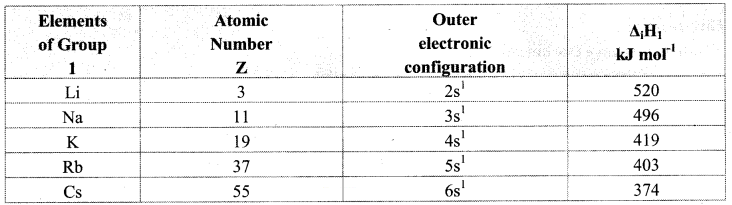
iii. Variation of ionization energy down the group: On moving down the group, the ionization enthalpy decreases. This is because electron is to be removed from the larger valence shell. Screening due to core electrons goes on increasing and the effective nuclear charge decreases down the group. As a result, the removal of the outer electron becomes easier down the group.
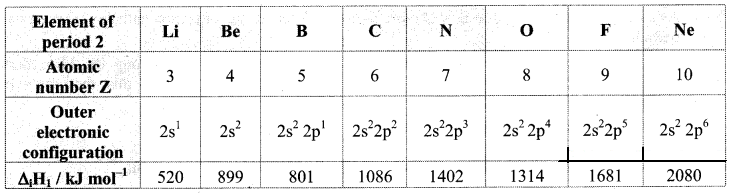
iv. Variation of ionization energy across a period: The screening effect is the same while the effective nuclear charge increases across a period. As a result, the outer electron is held more tightly and hence, the ionization enthalpy increases across a period. Therefore, the alkali metal shows the lowest first ionization enthalpy while the inert gas shows the highest first ionization enthalpy across a period.
Note: First ionization enthalpy values of elements of group $1$.
Image
Note: First ionization enthalpy values of elements of period $2.$
Image

Need a full question paper?

Generate a complete, print-ready paper with questions like this in minutes — across 16+ boards, with answer keys.
Start Generating Free