Question
Define lanthanoid contraction. Explain its effects.
Answer

Lanthanoid contraction:-
With an increasing atomic number in the lanthanoid series, there is a progressive decrease in the atomic as well as ionic radii of trivalent ions from $La^{3+}$ to $Lu^{3+.}$
This regular decrease $($contraction$)$ in the size of the atoms and ions with increasing atomic number is known as lanthanoid contraction.
Effects of lanthanoid contraction:-
$(a)$ Effects on the basic strength of hydroxides: As the size of the lanthanoid ions decreases from $La^{3+}$ to $Lu^{3+},$ the covalent character of the hydroxides increases. Thus, the basic strength decreases. Hence, $La(OH)_3$ is most basic, while $Lu(OH)_3$ is the least basic.
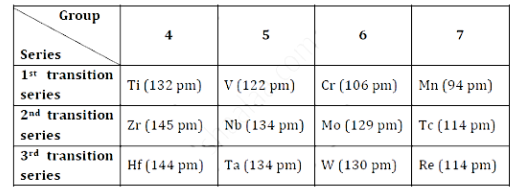
$(b)$ Ionic radii of post lanthanoids: The elements which follow the lanthanoids in the third transition series are known as post lanthanoids. As a result of lanthanoid contraction, the atomic radii $($size$)$ of the elements which follow lanthanum $(Hf, Ta, W$ etc.$)$ are similar to those of the elements of the previous period. There is normal increase in size from $Sc$ to $Y$ to $La.$ This trend disappears after the lanthanoids, and pairs of elements $Zr–Hf ($group $4), Nb–Ta ($group $5), Mo–W ($group $6)$ and $Tc–Re ($group $7)$ have almost identical sizes. These atoms possess similar number of valence electrons and similar properties. These pairs of elements are called ‘chemical twins’. The elements of the second and third transition series resemble each other more closely than the elements of the first and second transition series.
Image
$(c)$ Difficulty in separation of lanthanoids:- Because the changes in ionic radii $($size of the ions$)$ in the lanthanoids are very small, their chemical properties are similar. This makes the separation of the lanthanoids in the pure state difficult. However, lanthanoid contraction results in slight difference in the size of the lanthanoids which results in the differences in properties such as solubility, complex formation, hydration, basic character of their hydroxides etc. Because of these differences, the lanthanoids can be separated by the ion exchange method.

Need a full question paper?

Generate a complete, print-ready paper with questions like this in minutes — across 16+ boards, with answer keys.

Start Generating Free

Similar questions

State whether $\Delta S$ is positive, negative or zero for the following reactions.
i. $2 H _{2(g)}+ O _{2(g)} \rightarrow 2 H _2 O _{( l )}$
ii. $CaCO _{3(s)} \rightarrow CaO _{( s )}+ CO _{2(g)}$
Predict the products when
$(1)$ dimethyl acetylene
$(2)$ ethyl acetylene and
$(3)$ diethyl acetylene are treated with mercuric sulphate in dilute sulphuric acid.
Marine life like fish prefers to stay at lower level in water. Explain.
###
Explain, why do aquatic animals prefer to stay at lower level of water during summer?
What is the action of hydrogen cyanide on the following :
(1) Acetaldehyde
(2) Acetone
(3) Benzaldehyde?
What are the characteristic properties of solids?
How is benzoic acid prepared from alkyl benzenes ?###How will you convert the following :
(1) n-butyl benzene to benzoic acid.
(2) Toluene to benzoic acid.
(3) Cumene to benzoic acid ?
Write and explain reactions to convert propan-l-ol into propan-$2-ol$.
Classify the complexes as homoleptic and heteroleptic:
(a) $\left[ Co \left( NH _3\right)_5 Cl \right] SO _4$
(b) $\left[ CO ( ONO )\left( NH _3\right)_5\right] Cl _2$,
(c) $\left[ CoCl \left( NH _3\right)( en )_2\right]^{2+}$ and
(d) $\left[ Cu \left(C2O_4\right)_3\right]^{3-}$
Write chemical reactions to convert –COOH group of acetic acid into the following.
$CH_4$
Calculate $\Delta S_{\text {Total }}$ and hence show whether the following reaction is spontaneous at $25^{\circ} C$.
$\begin{aligned}
& Hg _{( s )}+ O _{2( g )} \rightarrow Hg _{( l )}+ SO _{2( g )} \Delta H ^0=-238.6 kJ \\
& \Delta S ^0=+36.7 JK ^{-1}
\end{aligned}$