Question
Define longitudinal wave motion. What are the essential conditions required for the formation of longitudinal wave motion?

Answer

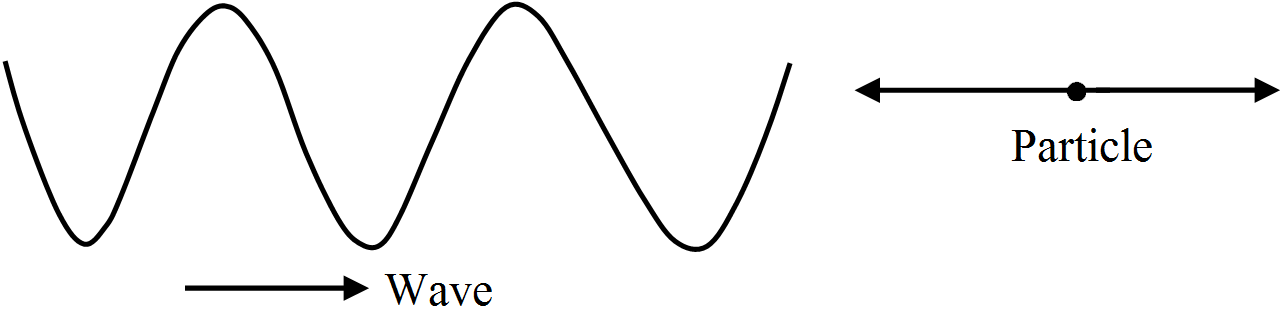
It is that wave motion in which the particles of the medium through which the wave is travelling vibrate in a direction parallel to the direction of the motion of the wave. In the figure given below, the wave is travelling from left to right and the particles of the medium vibrate in the horizontal direction simple harmonically. It represents the longitudinal wave motion.
For their propagation, the medium must possess:
  1. Elasticity.
  2. Inertia.
  3. Absence of frictional resistance.

Need a full question paper?

Generate a complete, print-ready paper with questions like this in minutes — across 16+ boards, with answer keys.
Start Generating Free

Similar questions

Calculate the work done by a car against gravity in moving along a straight horizontal road. The mass of the car is 400kg and the distance moved is 2m.
A satellite is moving in a circular orbit of radius $R$. If the radius is increased to $1.02 R$ then what will be the percentage change in its period?
A cylindrical capacitor is constructed using two coaxial cylinders of the same length $10\ cm$ and of radii $2\ mm$ and $4\ mm:$
  1. Calculate the capacitance.
  2. Another capacitor of the same length is constructed with cylinders of radii $4\ mm$ and $8\ mm$. Calculate the capacitance.
A material has poission's ratio 0.5. If a uniform rod of it undergoes a longitudinal strain of $2 \times 10^{-3}$. What is the percentage increases in its volume.
A piece of an alloy of mass 96gm is composed of two metals whose specific gravities are 11.4 and 7.4. If the weight of the alloy is 86gm in water, find the mass of each metal in the alloy.
The changes in a function y and the independent dy variable x are related as $\frac{\text{dy}}{\text{dx}}=\text{x}^2.$ Find y as a function of x.
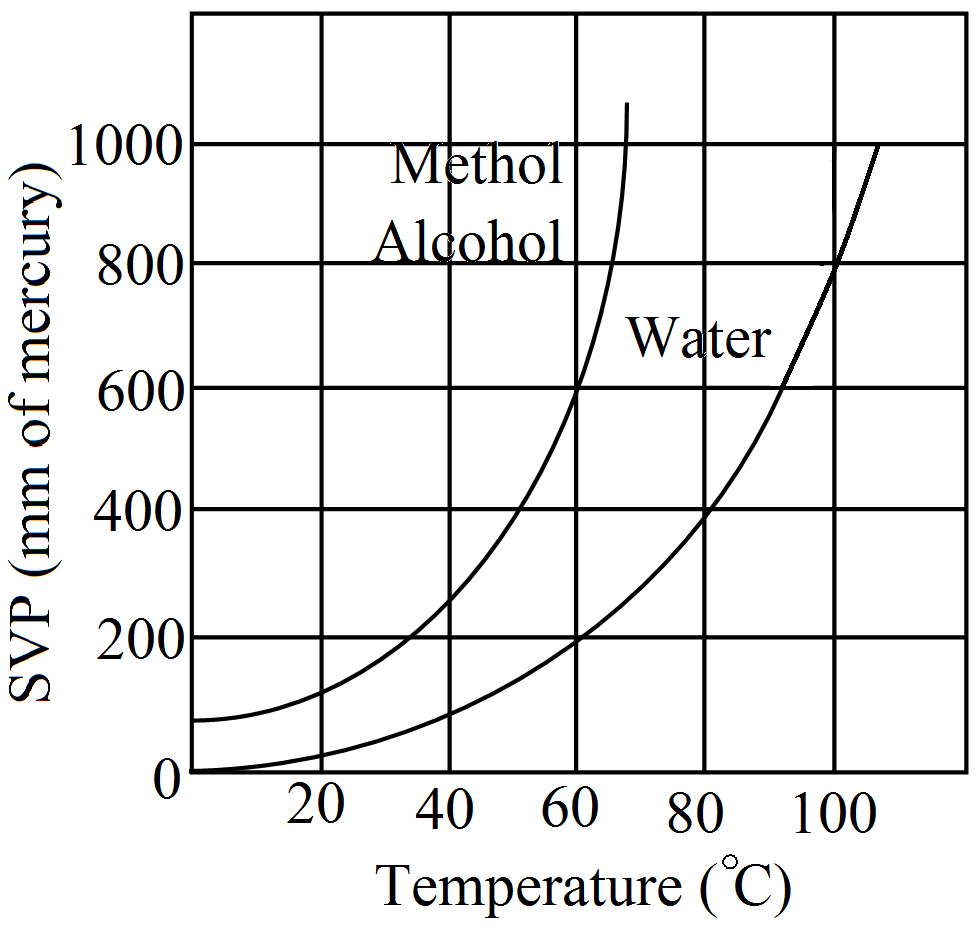
Using figure. of the text, find the boiling point of methyl alcohol at 1atm (760mm of mercury) and at 0.5atm.
A plate of thickness $t$ made of a material of refractive index $\mu$ is placed in front of one of the slits in a double slit experiment.
  1. Find the change in the optical path due to introduction of the plate.
  2. What should be the minimum thickness $t$ which will make the intensity at the centre of the fringe pattern zero? Wavelength of the light used is $\lambda$. Neglect any absorption of light in the plate.
A nucleus is at rest in the laboratory frame of reference. Show that if it disintegrates into two smaller nuclei, the products must be emitted in opposite directions.
The viscous force 'F' acting on a body of radius 'r' moving with a velocity 'v' in a medium of coefficient of viscosity $'\eta'$ is given by $\text{F}=6\pi\eta\text{rv}$ Check the correctness of the formula.