Question
Define magnifying power of a telescope. Write its expression.
A small telescope has an objective lens of focal length 150 cm and an eye piece of focal length 5 cm. If this telescope is used to view a 100m high tower 3 km away, find the height of the final image when it is formed 25 cm away from the eye piece.

Answer

  1. Magnifying power is the ratio of the angle subtended at the eye by the image to the angle subtended at the unaided eye by the object.

Expression

$\text{m} = \beta\big/\alpha = \text{f}_{o}\big/\text{f}_{e}$

or $\text{m} = \text{f}_{o} /_{ \text{f}_{e}}\bigg(1 + \frac{\text{f}_{e}}{\text{D}}\bigg)$

  1. Using, the lens equation for objective lens,:

$\frac{1}{\text{f}_{o}} =\frac{1}{\text{v}_{o}}-\frac{1}{\text{u}_{o}}$

$ => \frac{1}{150} = \frac{1}{\text{v}_{o}} - \frac{1}{-3\times10^{5}}$

$ => \frac{1}{\text{v}_{o}} =\frac{1}{150} -\frac{1}{-3\times10^{5}} = \frac{2000-1}{3\times10^{5}}$

$ =>\text{v}_{o} = \frac{3\times10^{5}}{1999}\text{cm}$

$\approx 150 \text{cm}$

Hence, magnification due to the objective lens

$\text{m}_{o} =\frac{\text{v}_{o}}{\text{u}_{o}} = \frac{150\times10^{-2}\text{m}}{3000\text{m}}$

$\approx\frac{10^{-2}}{20} = .05\times10^{-2}$

Using lens formula for eyepiece

$\frac{1}{\text{f}_{e}} =\frac{1}{\text{v}_{e}} - \frac{1}{\text{u}_{e}}$

$ = > \frac{1}{5} = \frac{1}{-25} -\frac{1}{\text{u}_{e}}$

$ = > \frac{1}{\text{u}_{e}} =\frac{1}{-25} - \frac{1}{5} = \frac{-1-5}{25}$


$ = >\text{u}_{e} =\frac{-25}{6}\text{cm}$

$\therefore\text{ Magnification due to eyepiece} \text{ m}_{e} =\frac{-25}{-\frac{25}{6}}= 6 $

Hence, total magnification $ = > \text{m} = \text{m}_{e}\times\text{m}_{o}$

$\text{m} = 6 \times5\times10^{-4} = 30 \times10^{-4}$

Hence, size of final image

$ = 30 \times10^{-4}\times100 \text{m}$

$ = 30 \text{ cm}.$
Need a full question paper?

Generate a complete, print-ready paper with questions like this in minutes — across 16+ boards, with answer keys.

Start Generating Free

Similar questions

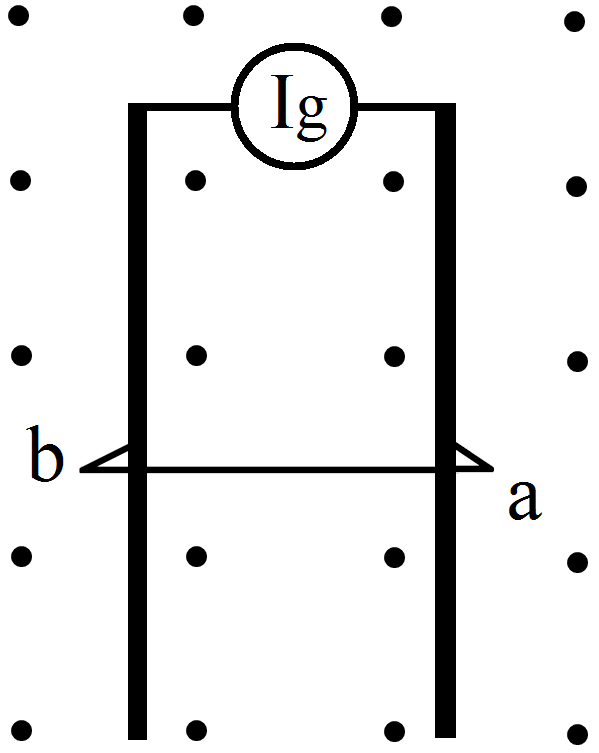
The system containing the rails and the wire of the previous problem is kept vertically in a uniform horizontal magnetic field B that is perpendicular to the plane of the rails (figure). It is found that the wire stays in equilibrium. If the wire ab is replaced by another wire of double its mass, how long will it take in falling through a distance equal to its length?

A thin lens made of a material of refractive index $\mu_2$ has a medium of refractive index $\mu_1$ on one side and a medium of refractive index $\mu_3$ on the other side. The lens is biconvex and the two radii of curvature have equal magnitude R. A beam of light travelling parallel to the principal axis is incident on the lens. Where will the image be formed if the beam is incident from:
  1. The medium $\mu_1$
  2. From the medium $\mu_3?$
Consider a non-conducting plate of radius r and mass m that has a charge q distributed uniformly over it. The plate is rotated about its axis with an angular speed $\omega.$ Show that the magnetic moment $\mu$ and the angular momentum of the plate are related as $\mu=\frac{\text{q}}{2\text{m}}\text{l}.$
Determine the current in each branch of the network shown in Fig. 3.17.
Image
Three identical charges, each having a value 1.0 × 10-8C, are placed at the corners of an equilateral triangle of side 20cm. Find the electric field and potential at the centre of the triangle.
Find the magnitude of the electric field at a point 4cm away from a line charge of density 2 × 10⁻⁶Cm-1.
A card sheet divided into squares each of size 1 mm2 is being viewed at a distance of 9 cm through a magnifying glass (a converging lens of focal length 9 cm) held close to the eye.
(a) What is the magnification produced by the lens? How much is the area of each square in the virtual image?
(b) What is the angular magnification (magnifying power) of the lens?
(c) Is the magnification in (a) equal to the magnifying power in (b)? Explain.
A coil of inductance 0.50H and resistance 100Ω is connected to a 240V, 50Hz ac supply.
  1. What is the maximum current in the coil?
  2. What is the time lag between the voltage maximum and the current maximum?
Prove that due to a charged layer of infinite expansion, the value of the electric field at any point near it does not depend on the area of the surface and the distance from the layer . i.e., the electric field remains uniform at points near the layer.###Write Gauss'law.By applying this rule,find the value of the electric field due to a uniformly charged infinite plane sheet at any point near the sheet.
A long wire carries a current of 4.00A. Find the energy stored in the magnetic field inside a volume ot 1.00mm at a distance of 10.0cm from the wire.