Question
Define motion. What do you understand by the terms ‘uniform motion’ and ‘non-uniform motion’? Explain with examples.

Answer

A body is said to be in motion when its position changes continuously with respect to a stationary point taken as the reference point.

  • Uniform motion: A body is said to be in uniform motion if it travels equal distances in equal intervals of time in a particular direction, no matter how small these time intervals are.

For example: A car running at a constant speed of 10m/s towards east will cover the equal distance of 10m every second towards east, so its motion will be uniform.

  • Non-uniform motion: A body is said to be in non-uniform motion if it travels unequal distances in equal intervals of time.

For example: Motion of a freely falling ball from the roof of a tall building.

Need a full question paper?

Generate a complete, print-ready paper with questions like this in minutes — across 16+ boards, with answer keys.

Start Generating Free

Similar questions

How will you separate a mixture of common salt, sulphur powder and sand?

A girl of mass 50kg jumps out of a rowing boat of mass 300kg on to the bank, with a horizontal velocity of 3m/s. With what velocity does the boat begin to move backwards?

A liquid compound X of molecular mass 18u can be obtained from a number of natural sources. All the animals and plants need liquid X for their survival. When an electric current is passed through 200 grams of pure liquid X under suitable conditions, then 178 grams of gas Y and 22 grams of gas Z are produced. Gas Y is produced at the positive electrode whereas gas Z is obtained at the negative electrode. Moreover, gas Y supports combustion whereas gas Z burns itself causing explosions.
  1. Name (i) liquid X (ii) gas Y, and (iii) gas Z
  2. What is the ratio to the mass of element Z to the mass of element Y in the liquid X?
  3. Which law of chemical combination is illustrated by this example?
  4. Name two sources of liquid X.
  5. Gate an important use of Y in our life.
Explain the mechanism of compost formation.

Two objects having equal masses are moving with uniform velocities of 2m/s and 6m/s respectively. Calculate the ratio of their kinetic energies.
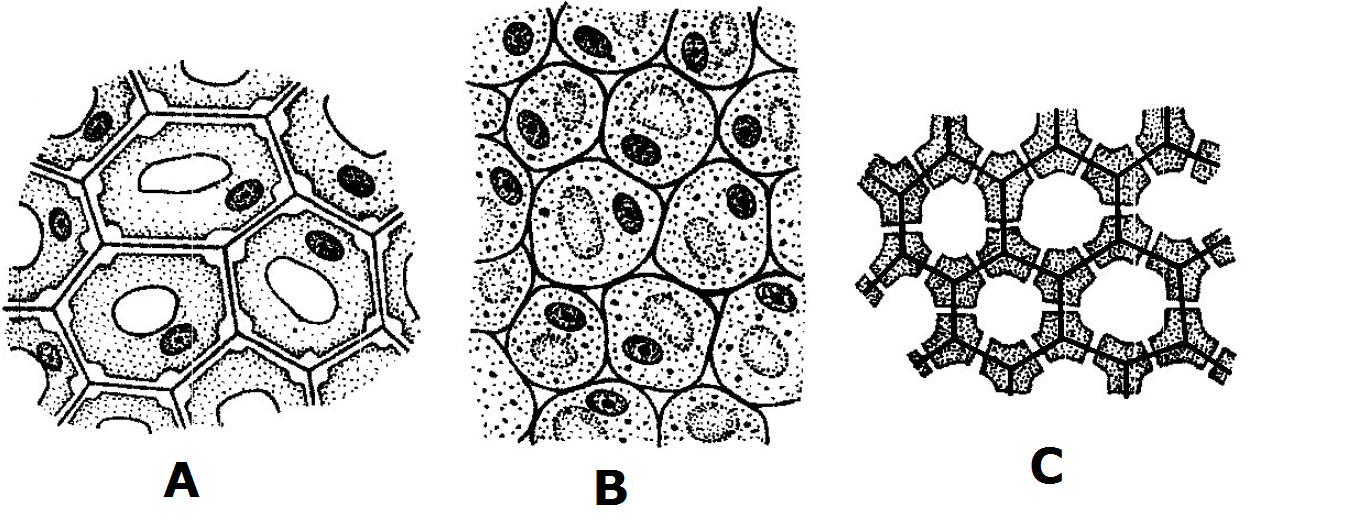
Distinguish between longitudinal and transverse waves.

  1. Identify Figure A, B and C.
  2. Which one of them has heavy deposition of lignin?
  3. Which one of them provides both mechanical strength as well as flexibility?
  4. Which one of them can be modified to form air cavities in awuatic plants?
  5. Which one of them is commercially exploited to obtain Hemp and Jute?
Carry out the following osmosis experiment:
Take four peeled potato halves and scoop each one out to make potato cups, one of these potato cups should be made from a boiled potato. Put each potato cup in a trough containing water. Now,
  1. Keep cup A empty.
  2. Put one teaspoon sugar in cup B.
  3. Put one teaspoon salt in cup C.
  4. Put one teaspoon sugar in the boiled potato cup D.
Keep these for two hours. Then observe the four potato cups and answer the following:
  1. Explain why water gathers in the hollowed portion of B and C.
  2. Why is potato A necessary for this experiment?
  3. Explain why water does not gather in the hollowed out portions of A and D.

Discuss:

  1. Principles of treatment.
  2. Vaccination.
How will the equations of motion for an object moving with a uniform velocity change?