Question
Define one ampere in international unit system.

Answer

One ampere is that electric current which in air or vacuum when flows through two long straight parallel wires at a distance of one meter produces a force of $2 \times 10^{-7} N / m$ in the wires.

Need a full question paper?

Generate a complete, print-ready paper with questions like this in minutes — across 16+ boards, with answer keys.

Start Generating Free

Similar questions

Can a photon be deflected by an electric field? By a magnetic field?
When an electrical component $X$ is joined with any ac circuit, then current in it is ahead of phase of voltage by $\frac{\pi}{2}$ radian. Identify X and write an expression for its reactance.
A point source of light moves in a straight line parallel to a plane table. Consider a small portion of the table directly below the line of movement of the source. The illuminance at this portion varies with its distance r from the source as:

  1. $\text{I}\propto\frac{1}{\text{r}}$

  2. $\text{I}\propto\frac{1}{\text{r}^2}$

  3. $\text{I}\propto \frac{1}{\text{r}^3}$

  4. $\text{I}\propto\frac{1}{\text{r}^4}$

On what does the value of magnification ( $m$ ) depend in a concave mirror and what type is the value of $( m )$ always in a convex mirror?
What type of wave front will emerge?
(i) From a point light source, (ii) From a remote light source.
A biconcave lens made of a transparent material of refractive index 1.25 is immersed in water of refractive index 1.33. Will the lens behave as a converging or a diverging lens? Give reason.
Find the force exerted by the water on a 2m2 plane surface of a large stone placed at the bottom of a sea 500m deep. Does the force depend on the orientation of the surface?
What is the reason that the numbers of absorption transitions is less than the emission transition in atom?
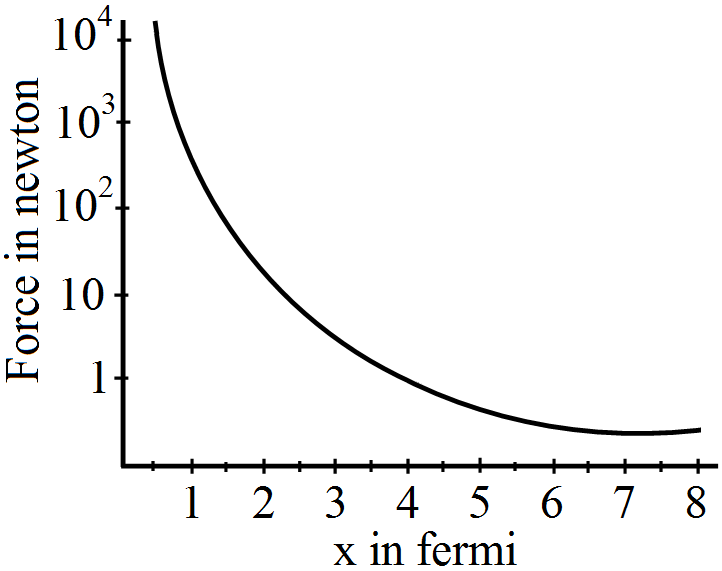
Suppose the magnitude of Nuclear force between two protons varies with the distance between them as shown in figure. Estimate the ratio "Nuclear force/Coulomb force" for:
  1. x = 8fm
  2. x = 4fm
  3. x = 2fm
  4. x = 1fm (1fm = 10-15m).

Whose wavelength is minimum among the following:Micro waves, Ultraviolet radiation and X-rays.