Question
Define power. Obtain an expression for it in terms of force and velocity.

Answer

Power The rate of doing work is called power.
$\text{P}=^{\ \ \text{Lt}}_{\Delta\text{t}\rightarrow0}\frac{\Delta\text{W}}{\Delta\text{t}}=\frac{\text{d}\text{W}}{\text{d}\text{t}}$
$=\frac{\text{d}}{\text{d}\text{t}}(\vec{\text{F}}.\vec{\text{S})}=\vec{\text{F}.}\frac{\text{d}\vec{\text{s}}}{\text{dt}}$
$\text{P}=\vec{\text{F}.}\vec{\text{V}}$
$\Rightarrow\text{P}=\text{Fv}$

Need a full question paper?

Generate a complete, print-ready paper with questions like this in minutes — across 16+ boards, with answer keys.
Start Generating Free

Similar questions

It is well known that a raindrop falls under the influence of the downward gravitational force and the opposing resistive force. The latter is known to be proportional to the speed of the drop but is otherwise undetermined. Consider a drop of mass $1.00 g$ falling from a height $1.00 km$. It hits the ground with a speed of $50.0 m s ^{-1}$. (a) What is the work done by the gravitational force? What is the work done by the unknown resistive force?
Set up a relation between speed of sound in a gas and root mean square velocity of the molecules of that gas.
Absolute zero temperature is not the temperature of zero energy. Explain.
State three basic laws of motion. Show that the first law of motion gives the definition of force and the second law of motion gives the measure of force.
A capillary tube is attached horizontally to a constant head arrangement. If the radius of the capillary tube is increased by 10% then by what percentage the rate of flow of liquid will change.
A satellite is revolving around the earth, close to the surface of earth with a kinetic energy E. How much kinetic energy should be given to it so that it escapes from the surface of earth?
Discuss elastic collision in one dimension. Obtain expression for velocities of two bodies after such a collision.
The radius of a sphere is measured as $(2.1 \pm 0.5) \text{cm}$ calculate its surface area with error limits.
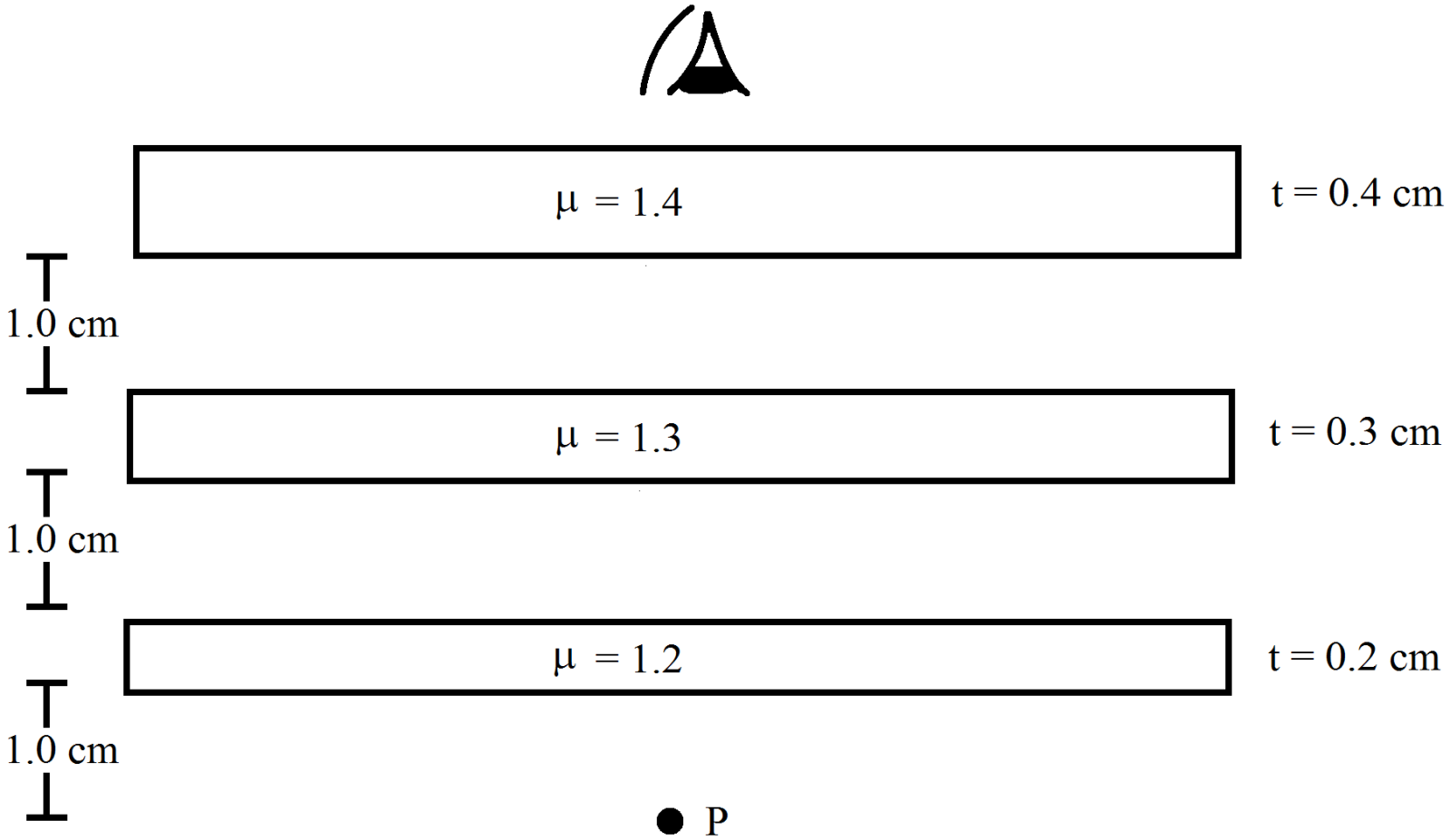
Locate the image of the point P as seen by the eye in the figure.

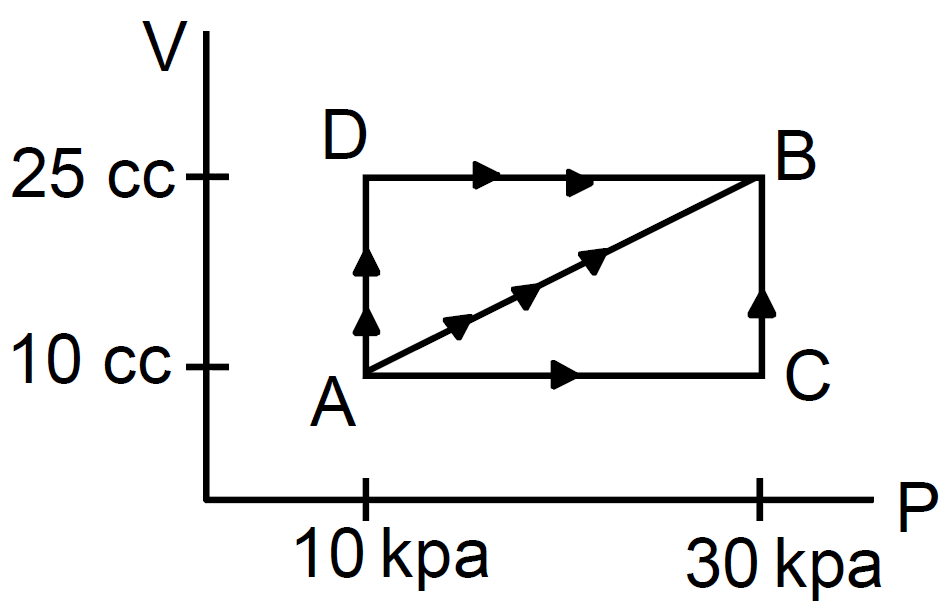
Figure. shows three paths through which a gas can be taken from the state A to the state B. Calculate the work done by the gas in each of the three paths.