Question
  1. Define self $-$ inductance. Write its $SI$ units.
  2. A long solenoid with $15$ turns per $\ cm$ has a small loop of area $2.0 \ cm^2$ placed inside the solenoid normal to its axis. If the current carried by the solenoid changes steadily from $ 2.0 A$ to $4.0 A$ in $0.1 s,$ what is the induced emf in the loop while the current is changing?
Answer

  1. Self $-$ inductance is the amount of magnetic flux linked with a coil when a unit current flows through it.
$($Alternatively, It is the amount of emf induced in a coil when current through it changes at the rate of $1 A$ per second.$)$
$S.I.$ Unit: henry $(H)$
  1. Magnetic field inside the solenoid $, B=\mu_0\text{n I}$
Induced emf in the loop, $\epsilon=\frac{d\phi_B}{dt}$
$=A\frac{dB}{Dt}$
$=\mu_0nA\frac{dI}{dt}$
$=4\pi\times10^{-7}\times1500\times2\times10^{-4}\times\frac{(4-2)}{0.1}\text{V}$
$=7.5\times10^{-6}\text{V}$

Need a full question paper?

Generate a complete, print-ready paper with questions like this in minutes — across 16+ boards, with answer keys.

Start Generating Free

Similar questions

A parallel$-$plate capacitor with plate area $20\ cm^2$ and plate separation $1.0\ mm$ is connected to a battery. The resistance of the circuit is $10\text{k}\Omega.$ Find the time constant of the circuit.
To increase the current sensitivity of a moving coil galvanometer by $50\%,$ its resistance is increased so that the new resistance becomes twice its initial resistance. By what factor does its voltage sensitivity change?
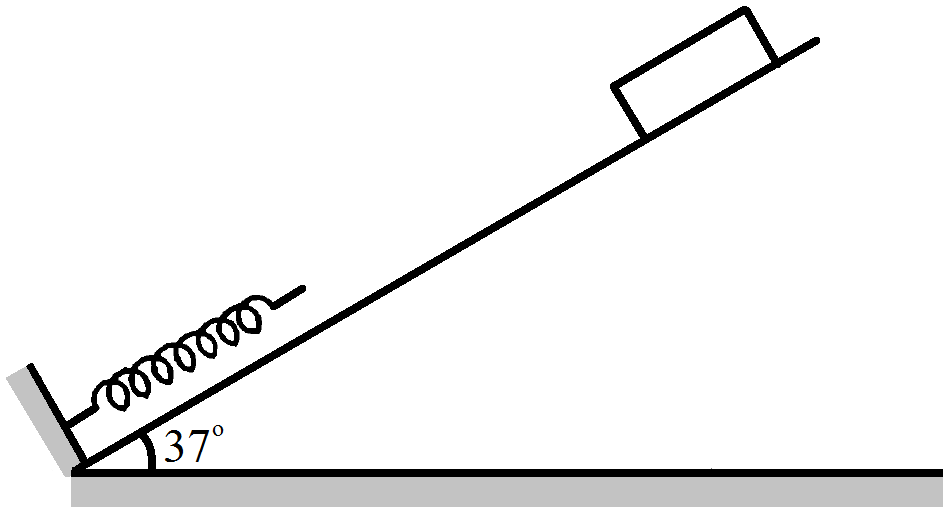
Figure shows a spring fixed at the bottom end of an incline of inclination $37^\circ$. A small block of mass $2\ kg$ starts slipping down the incline from a point $4.8\ m$ away from the spring. The block compresses the spring by $20\ cm,$ stops momentarily and then rebounds through a distance of $1\ m$ up the incline. Find.
  1. The friction coefficient between the plane and the block.
  2. The spring constant of the spring. Take $g = 10m/s^2.$
What is interference of light? Give one example of interference in our daily life.
A circular coil of wire consisting of $100$ turns, each of radius $8.0 \ cm$ carries a current of $0.40 A.$ What is the magnitude of the magnetic field $B$ at the centre of the coil?
Two particles have equal masses of $5.0g$ each and opposite charges of $ +4.0 \times 10^{-5}C$ and $-4.0 \times 10^{-5}C$. They are released from rest with a separation of $1.0m$ between them. Find the speeds of the particles when the separation is reduced to $50\ cm$.
A solenoid of length $1.0m,$ radius $1\ cm$ and total turns $1000$ wound on it, carries a current of $5A$. Calculate the magnitude of the axial magnetic field inside the solenoid. If an electron was to move with a speed of $104ms^{–1}$ along the axis of this current carrying solenoid, what would be the force experienced by this electron?
  1. State Bohr’s quantization condition for defining stationary orbits. How does de Broglie hypothesis explain the stationary orbits?
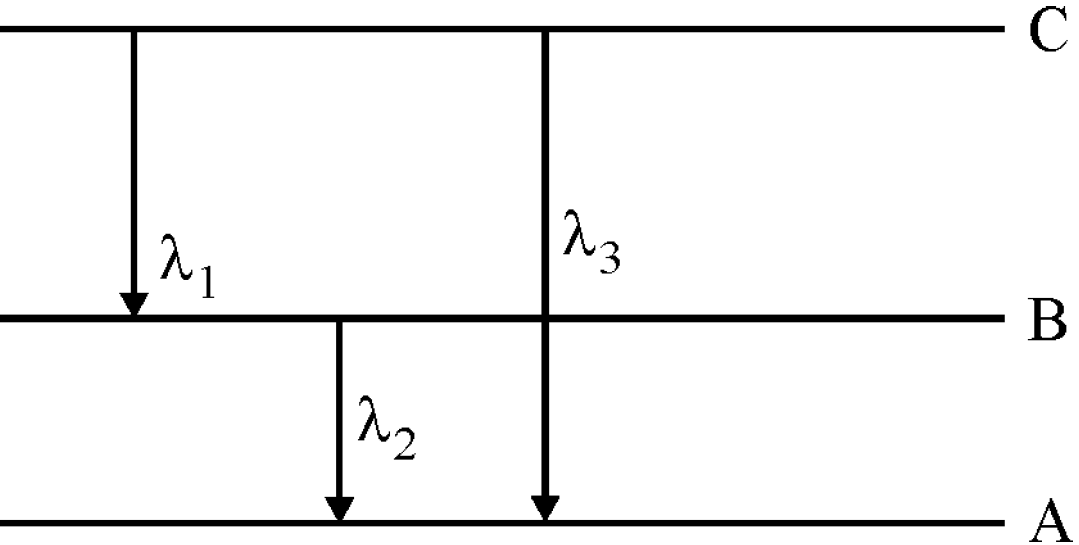
  2. Find the relation between the three wavelengths$\lambda_{1} , \lambda_{2}$ and$\lambda_{3}$ from the energy level diagram shown below.
A solenoid has a core of a material with relative permeability 400 . The windings of the solenoid are insulated from the core and carry a current of 2A. If the number of turns is 1000 per metre, calculate (a) $H$, (b) $M$, (c) $B$ and (d) the magnetising current $I_m$.
An ammeter and a milliammeter are converted from the same galvanometer. Out of the two, which current measuring instrument has a higher resistance?