Question
Define ‘speciation’. Explain how speciation occurs.

Answer

The process by which new species develop from the existing species is known as speciation. New species are formed when the population of same species splits into two separate groups which then get isolated from each other geographically by the barriers such as mountain ranges, rivers or the sea. The geographical isolation of the two groups of population leads to their reproductive isolation due to which no genes are exchanged between them. However, breeding continues within the isolated populations producing more and more generations. Over the generations, the processes of genetic drift (random change in gene frequency), and natural selection operate in different ways in the two isolated groups of population and make them more and more different from each other. After thousands of years, the individuals of these isolated groups of population become so different that they will be incapable of reproducing with each other even if they happen to meet again. We then say that two new species have been formed.
Need a full question paper?

Generate a complete, print-ready paper with questions like this in minutes — across 16+ boards, with answer keys.

Start Generating Free

Similar questions

Read the passage and answer the questions based on it.
If heat is exchanged between a hot and cold object, the temperature of the cold object goes on increasing due to gain of energy and the temperature of the hot object goes on decreasing due to loss of energy. The change in temperature continues till the temperatures of both objects attain the same value. In this process, the cold object gains heat energy and the hot object loses heat energy. If the system of both the objects is isolated from the environment by keeping it inside a heat-resistant box then no energy can flow from inside the box or come into the box. In this situation, we get the following principle.
Heat energy lost by the hot object = Heat energy gained by the cold object. This is called the ‘Principle of heat exchange’.
  1. Where does heat transfer take place?
  2. In such a situation which principle of heat do you perceive?
  3. How can this principle be explained in short?
  4. Which property of the substance is measured using this principle?
Draw a neat labelled diagram: Magnetic separation method.
Gender of child is determined by the male partner of couple. Explain with reasons whether this statement is true or false.
A nuclear reaction is represented by the equation:$^{2}_{1}\text{H}+{^{2}_{1}\text{H}}\rightarrow{^{3}_{2}\text{He}}+\text{xc}+\text{E}$
  1. Name the process represented by this equation and describe what happens during this reaction.
  2. Identify the particle c and the number x of such particles produced in the reaction.
  3. What does E represent?
  4. State two conditions under which such a reaction takes place.
  5. What type of nuclear bomb is based on similar reactions?
Which are the reasons for endangering the species of plants and animals? How can we save those?
Balance the following equation stepwise.
Take into account the time required for following processes. Classify them into two groups and give titles to the groups.
(i) Cooking gas starts burning on ignition.
(ii) Iron article undergoes rusting.
(iii) Erosion of rocks takes place to form soil.
(iv) Alcohol is formed on mixing yeast in glucose solution under proper condition.
(v) Effervescence is formed on adding baking soda into a test tube containing dilute acid.
(vi) A white precipitate is formed on adding dilute sulphuric acid to barium chloride solution.
Explain the following with the help of a diagram :
Myopia or Nearsightedness
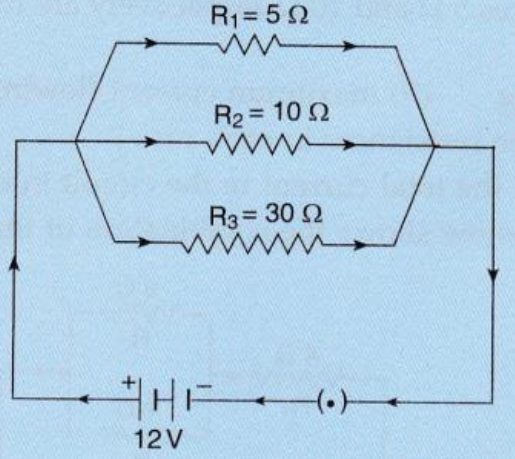
In the circuit diagram given below, three resistors R R , and R of $5 Ω, 10 Ω$ and $30 Ω,$ respectively are connected as shown.
Calculate:
  1. Current through each resistor.
  2. Total current in the circuit.
  3. Total resistance in the circuit.
How do carbohydrates, fats and proteins get digested in human beings?
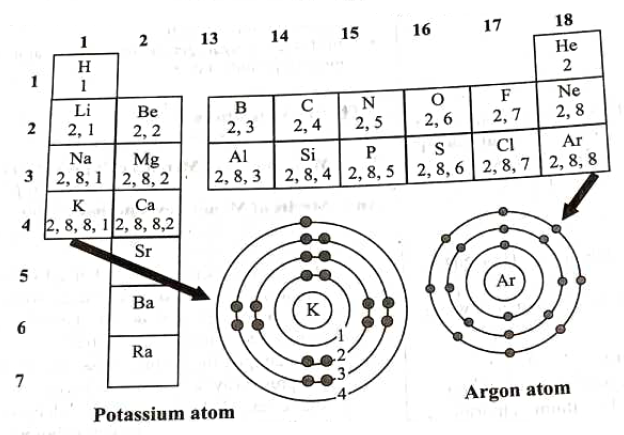
Observe the following diagram and write the answers of the following questions:
Image
i. Write the atomic numbers of first two elements in the second group.
ii. Write the number of valence electrons of the elements in the halogen group.
iii. Draw the diagram of electronic configuration of magnesium atom.
iv. After completion of a period, what change does take place in the electronic configuration of the next element?
v. Write the names of any two elements from the diagram which do not take part in chemical reaction.