Question
Define standing wave. Displacement of a string in which standing wave is formed is given as $\text{y}=(20\sin157\text{x}\cos314\text{t})$ Find:
  1. Amplitude of individual waves.
  2. Velocity of wave.

Answer

A standing wave is a pattern generated due to the superposition of two waves moving in opposite direction. It has varying amplitude.
$\text{Y} =20\sin157\text{x}\cos314\text{t}$
On comparison with $\text{Y}=2\text{A}\sin\text{kx}\cos\omega\text{t}$
We have,
  1. Amplitude $= 10$ units.
  2. Velocity of wave $=\frac{\omega}{\text{k}}=\frac{314}{157}=2\text{ units}.$

Need a full question paper?

Generate a complete, print-ready paper with questions like this in minutes — across 16+ boards, with answer keys.

Start Generating Free

Similar questions

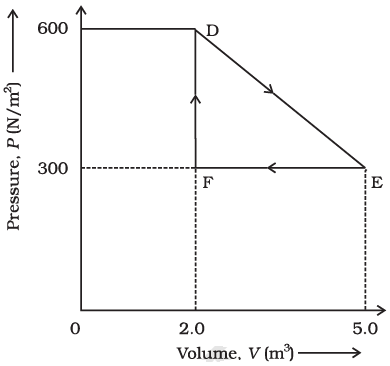
A thermodynamic system is taken from an original state to an intermediate state by the linear process shown in Fig.
Its volume is then reduced to the original value from E to F by an isobaric process. Calculate the total work done by the gas from D to E to F.
What is the direction of areal velocity of the earth around the sun?
The temperature and the relative humidity are $300K$ and $20\%$ in a room of volume $50m^3$. The floor is washed with water, $500g$ of water sticking on the floor. Assuming no communication with the surrounding, find the relative humidity when the floor dries. The changes in temperature and pressure may be neglected. Saturation vapour pressure at $300K = 3.3kPa$.
A man of mass $70kg$ stands on a weighing scale in a lift which is moving. Upwards with a uniform speed of $10 ms^{-1}$.
Prove that the vectors $\vec{\text{A}}=2\hat{\text{i}}-3\hat{\text{j}}+\hat{\text{k}}$ and $\vec{\text{B}}=\hat{\text{i}}+\hat{\text{j}}+\hat{\text{k}}$ are mutuallly perpendicular.
A helicopter of mass $500\ kg$ rises with a vertical acceleration of $10ms ^{-2}$. The weight of pilot is $60\ kg$. Give the magnitude and direction of :
  1. force on the floor of the helicopter by the pilot
  2. action of the rotor of the helicopter on the surrounding air
  3. force on the helicopter due to the surrounding air.
$($Take $g = 10 ms^{-2}).$
Visible light has wavelengths in the range of 400nm to 780nm. Calculate the range of energy of the photons of visible light.
Two blocks of equal mass m are tied to each other through a light string. One of the blocks is pulled along the line joining them with a constant force F. Find the tension in the string joining the blocks.
A cylinder rotating at an angular speed of $50rev/s$ is brought in contact with an identical stationary cylinder. Because of the kinetic friction, torques act on the two cylinders, accelerating the stationary one and decelerating the moving one. If the common magnitude of the acceleration and deceleration be one revolution per second square, how long will it take before the two cylinders have equal angular speed?
Molecules in air in the atmosphere are attracted by gravitational force of the earth. Explain why all of them do not fall into the earth just like an apple falling from a tree.