Question
Define the distance of closest approach.

Answer

The minimum distance upto which an energetic $\alpha$-particle travelling directly towards a nucleus can move before coming to rest and then retracing its path is known as distance of closest approach.
$F=\frac{1}{4 \pi \in_0} \frac{(2 e)(Ze)}{r^2}$
Where $r$ is the distance of $\alpha$-particle from nucleus.

Need a full question paper?

Generate a complete, print-ready paper with questions like this in minutes — across 16+ boards, with answer keys.
Start Generating Free

Similar questions

Suppose you are told that the linear size of everything in the universe has been doubled overnight. Can you test this statement by measuring sizes with a metre stick? Can you test it by using the fact that the speed of light is a universal constant and has not changed? What will happen if all the clocks in the universe also start running at half the speed?
Explain that in day to day life we can't get coherent sources using two sodium lamps.
The masses of 11C and 11B are respectively 11.0114u and 11.0093u. Find the maximum energy a positron can have in the $\beta^+$-decay of 11C to 11B.
The eyepiece of an astronomical telescope has a focal length of 10cm. The telescope is focused for normal vision of distant objects when the tube length is 1.0m. Find the focal length of the objective and the magnifying power of the telescope.
A tunnel is dug along a diameter of the earth. Find the force on a particle of mass m placed in the tunnel at a distance x from the centre.
Is work-energy theorem valid in non-inertial frames?
The frequency ν of incident radiation is greater than threshold frequency (ν0) in a photocell. How will the stopping potential vary if frequency (ν) is increased, keeping other factors constant?
Can you think of two particles which do not exert gravitational force on each other?
State conditions when resultant magnetic field at a point due to two long straight perpendicular current carrying wires can be zero.
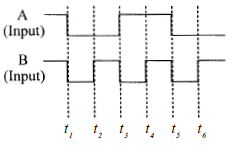
The given inputs A, B are fed to a 2-input NAND gate. Draw the output wave form of the gate.