Question
Define the following:
  1. Respiration.
  2. Respiratory substrate.
  3. How does a tree trunk exchange gases with the environment although it lacks stomata?
  4. Which is the most important energy carrier? Is this compound mobile?
  5. Name the major respiratory substrates used by most organisms. It unavailable at time, what other substances can be used for respiration?
Answer

  1. Enzymes controlled process of biological oxidation of various organic food materials in a living cell, producing $\mathrm{CO}_2$ and $\mathrm{H}_2 \mathrm{O}$, and releasing energy in the form of ATP, is called respiration.
  2. The organic compounds catabolised in the living cells to release energy are called respiratory substrates.
  3. Due to the presence of lenticels in the periderm which is connected internally to the network of parenchyma with outside world.
  4. The most important energy carrier is ATP. This energy rich compound is mobile, but cannot pass from one cell to another.
  5. Carbohydrates in condition of its unavailability, proteins, fats and organic acids can be used.

Need a full question paper?

Generate a complete, print-ready paper with questions like this in minutes — across 16+ boards, with answer keys.

Start Generating Free

Similar questions

List the hormones secreted by the following: Pituitary.
Sporozoans are parasitic protozoan protists which lack locomotory organelles atleast in trophozoite stage.
  1. Where are they found?
  2. What kind of nutrition they have?
  3. Do they have nucleus?
  4. What is the mode of reproduction?
  5. List any four examples of sporozoans.
Why biologists do not favour common names? Discuss briefly.
Akanksha, while walking in the garden in the morning with her mother observed two water drops falling on the ground. She thought that it is raining. Being curious, she started finding the source of the watery fluid. Then she observed drops falling from the leaves tip. She asked her mother, who was a botanist about this. The mother explained her that it is not due to the rain instead the water drops are dripping due to the phenomenon called guttation.
  1. What are hydathodes? Why are these called water glands?
  2. Where are hydathodes present?
  3. Name the process of water loss occurring via hydathodes.
  4. What value is displayed by Akanksha's nature?
What are the modifications that are observed in birds that help them fly?
Classify the plastids on the basis of the types of pigments found in them. State the function of each type.
How are the hypothalamic hormones transported to the target organs?
Light plays an important role in the life of all organisms. Name any three physiological processes in plants which are affected by light.
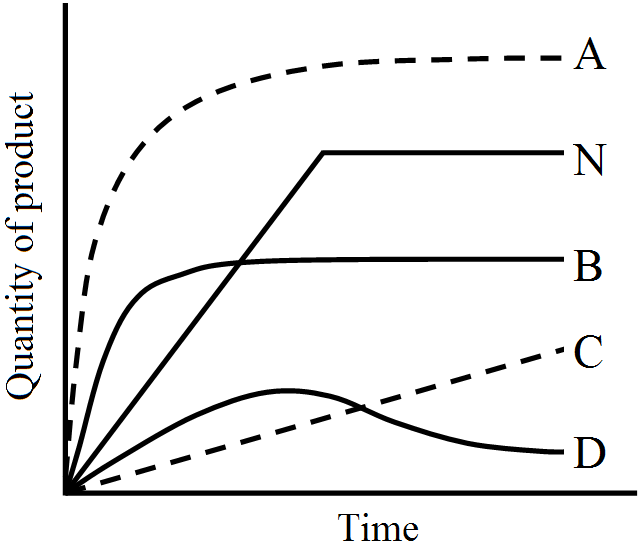
The lines A to D below show how change in temperature can affect the rate of enzyme reaction. Line N shows the rate of reaction under optimum temperature. Which line A, B, C or D shows the rate of enzyme reaction at 60°C?
Why reproduction is necessary? Is it essential for survival? If a living organism does not reproduce, in which category it will belong, living or non-living? How is sexual reproduction different from asexual reproduction.