Question
Define the following terms:
  1. Cell inclusions.
  2. Cytosol.
  3. Protoplasm.
  4. Nucleoplasm.

Answer

  1. Cell Inclusions: Cell inclusions are non-living materials present in the cytoplasm.
  2. Cytosol: It is the soluble part of cytoplasm and is located between cell organelles.
  3. Protoplasm: Nucleus and cytoplasm together are called protoplasm.
  4. Nucleoplasm: It is the liquid ground substance present in the nucleus.

Need a full question paper?

Generate a complete, print-ready paper with questions like this in minutes — across 16+ boards, with answer keys.
Start Generating Free

Similar questions

Explain water cycle in detail.
Define animal husbandry. Write about its scope.
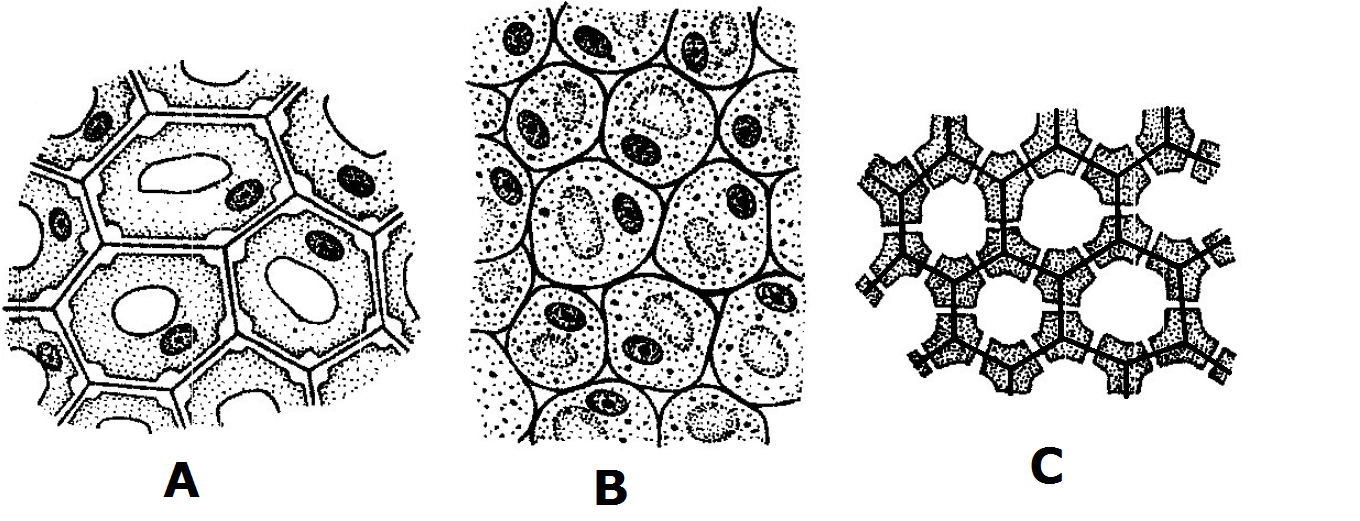
  1. Identify Figure $A, B$ and $C.$
  2. Which one of them has heavy deposition of lignin$?$
  3. Which one of them provides both mechanical strength as well as flexibility$?$
  4. Which one of them can be modified to form air cavities in awuatic plants$?$
  5. Which one of them is commercially exploited to obtain Hemp and Jute$?$
Write down four characters of Osteichthyes and give two examples.
What are the postulates of Bohr’s model of an atom?
How will you separate a mixture of common salt, sulphur powder and sand?
There are three substances $X, Y$ and $Z.$ The substance $X$ does not have a fixed melting point or boiling point and it still shows the individual properties of its constituents. The substance $Y$ is a pure substance which occurs in nature as such. The substance $Y$ has a fixed melting point and boiling point but it cannot be broken down into simpler substances by any chemical means. The substance $Z$ is also a pure substance whose properties are entirely different from those of its constituents. The substance $Z$ can, however, be divided by electrolysis into two substances which belong to the same class of substances as $Y.$
  1. What type of substance could $X$ be$?$ Name one substance like $X.$
  2. What type of substance could $Y$ be$?$ Name one substance like $Y.$
  3. What type of substance could $Z$ be$?$ Name one substance like $Z.$
  4. Whish process involves absorption or release of an appreciable amount of energy: formation of substance $X$ or formation of substance $Z?$
  5. Name the three groups into which all the substances like $Y$ are divided on the basis of their properties.
Describe the structure and functions of nucleus.
Define eutrophication. What is ill effect of eutrophication?
Describe the structure and function of different types of epithelial tissues. Draw diagram of each type of epithelial tissue.