Question
Define the following terms :
  1. Ideal solution.
  2. Molarity $(M).$

Answer

The solution which obey Roult's law over entire range of concentration are known as ideal solution.
For ideal solution: Enthalpy of mixing of the pure components to form the solution, $\triangle _{mix} H = 0$ and volume of mixing, $\triangle _{mix} V = 0$
  1. Molarity:
It is defined as the number of moles of solute present in $1000\ mL$ of the solution. Molarity is represented by $M.$
$\text{Molarity (M)}=\frac{\text{Number of moles of solute}}{\text{ volume of solution in mL}}\times1000$
or
$\text{M} = \frac{\text{Weight of solute}}{\text{molar mass of solute}\times \text{Volume of solution in mL}}\times1000$

Need a full question paper?

Generate a complete, print-ready paper with questions like this in minutes — across 16+ boards, with answer keys.
Start Generating Free

Similar questions

Arrange the following in decreasing order of their acidic strength and give reason for your answer.
$\ce{CH_3CH_2OH, CH_3COOH, ClCH_2COOH, FCH_2COOH, C_6H_5CH_2COOH}$
Calculate the mass percentage of aspirin (C9H8O4) in acetonitrile (CH3CN) when 6.5 g of C9H8O4 is dissolved in 450 g of CH3CN.
How would you account for the following: Cobalt$(II)$ is stable in aqueous solution but in the presence of complexing reagents it is easily oxidised.
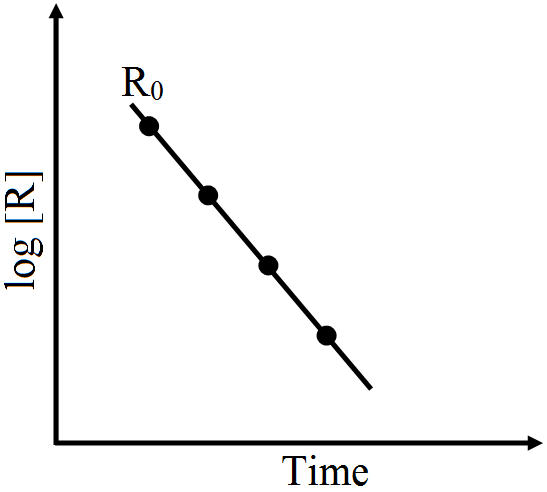
Observe the graph in diagram and answer the following questions.
  1. If slope is equal to $-2.0 \times 10^{-6} \sec^{-1} ,$ what will be the value of rate constant?
  2. How does the half-life of zero order reaction relate to its rate constant?
Explain the classification of alcohols and phenols on the basis of number of hydroxyl groups.
Explain the following :
(a) Transition elements show variable oxidation states.
(b) The paramagnetic character in $3 d$ transition series elements increases upto Mn and then decreases.
The rate of a particular reaction triples when temperature changes from $50^\circ C$ to $100^\circ C$. Calculate the activation energy of the reaction. $[\log 3 = 0.4771; R = 8.314 JK^{-1} mol^{-1}].$
The rate constant for the decomposition of hydrocarbons is $2.418 \times 10^{–5}s^{–1}$ at $546 K$. If the energy of activation is $179.9 kJ/mol$, what will be the value of pre-exponential factor.
Explain the solubility rule “like dissolves like” in terms of intermolecular forces that exist in solutions.
Define azeotropes. What type of azeotrope is formed by positive deviation from Raoult's law? Give an example.