Question
Define the following terms.
a. Sublimation
b. Filtration
c. Centrifugation
d. Crystallization
e. Distillation

Answer

a. Sublimation – The change of a solid directly into its vapour state without passing through its liquid state is called sublimation.
b. Filtration – The process of separating the fine insoluble solid particles from a solid-liquid mixture through a filter is called filtration.
c. Centrifugation – Centrifugation is a method for separating the fine suspended solid particles from a solid-liquid mixture by rotating the mixture in a centrifuge.
d. Crystallization – Crystallization is the process of separating a pure solid in the form of its chrystals from its solution.
e. Distillation – Distillation is the process of separation of a liquid from its solution with a solid constituent by heating the liquid to its vapour form and then cooling the vapour to get back the pure liquid.

Need a full question paper?

Generate a complete, print-ready paper with questions like this in minutes — across 16+ boards, with answer keys.

Start Generating Free

Similar questions

State two similarities and two differences between respiration and burning.
Match the statements in List I – 1 to 10 correct answers in List II-A to J.
List I LIst II
1 Fluorine and chlorine A Nitrogen
2 A diatomic molecule B Boron
3 A molecule containing the elements hydrogen and oxygen. C Reactants
4 A metalloid - showing properties of both metals and non-metals. D Chemical Formula
5 The term used for the substances which take part in the chemical reaction E Halogens
6 The term represents a substance by means of symbols. F Water
7 The term used for the substances formed as a result of a chemical reaction G Nitric Acid
8 A compound containing one atom of zinc and two atoms of chlorine. H Products
9 The chemical name for nitrogen monoxide. I Phosphorus
10 A polyatomic molecule. J Zinc Chloride

Give four main difference between a mixture and a compound.
State some important steps to avoid pollution of water.
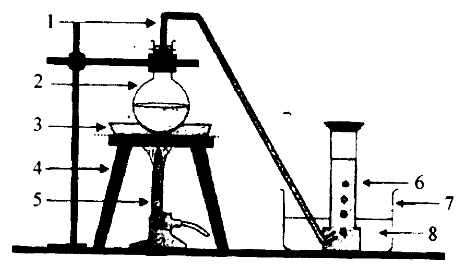
Label the marked equipment in the diagram given below.
Differentiate between: natural fibres & synthetic fibres.
State what is – Terylene. State some of its characteristic properties which make it suitable for commercial use
State what is meant by the term ‘conservation of water’.
State a few water-saving methods, which may be used in the home to conserve water.
Describe simple experiments to prove that solids have mass
List any five precautions taken care of while performing an experiment in a chemistry laboratory.
List five ways to reduce water pollution.