Question
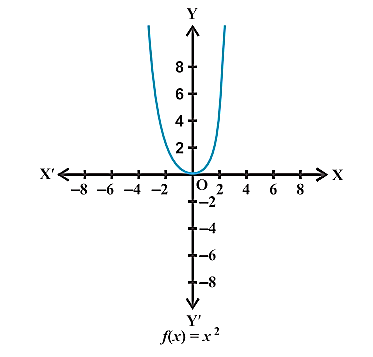
Define the function f: R $\rightarrow$ R by y = f(x) = x2, x $∈$ R. Complete the Table given below by using this definition. What is the domain and range of this function? Draw the graph of f.
x – 4 –3 –2 –1 0 1 2 3 4
y = f(x) = x2                  

Answer

The completed table is given below:

x – 4 –3 –2 –1 0 1 2 3 4
y = f (x) = x2 16 9 4 1 0 1 4 9 16

Domain of f = {x : x $\in$ R}. Range of f = {x2: x $\in$ R}. The graph of f is given by the figure shown below:

Need a full question paper?

Generate a complete, print-ready paper with questions like this in minutes — across 16+ boards, with answer keys.

Start Generating Free

Similar questions

A person writes a letter to four of his friends. He asks each one of them to copy the letter and mail to four different persons with instruction that they move the chain similarly. Assuming that the chain is not broken and that it costs 50 paise to mail one letter. Find the amount spent on the postage when 8th set of letter is mailed.
Let $A=\{a, e, i, o, u\}, B=\{a, d, e, o, v)$ and $C=\{e, o, t, m]$. Using Venn diagrams, verify that: $A \cup(B \cap C)=$ $(A \cup B) \cap(A \cup C)$
Solve the following linear inequations in R:
$\frac{3}{\text{x}-2}<1$
Show that A $\cup$ B = A $\cap$ B implies A = B
If in A.P. is such that $\frac{\text{a}_4}{\text{a}_7}=\frac{2}{3},$ find $\frac{\text{a}_6}{\text{a}_8}.$
An experiment consists of rolling a die until a 2 appears.
How many elements of the sample space correspond to the event that the 2 appears not later than the kth roll of the die?
[Hint: 1 + 5 + 52 + ... + 5k-1]
If $a, b, c$ are in G.P. prove that:
(i) $\log a^n, \log b^n, \log c^n$ are in G.P.
(ii) $\log a, \log b, \log c$ are in G.P.
(iii) $\left(a^2+b^2\right)\left(a^2+c^2\right)=(a b+b c)^2$
(iv) $a\left(b^2+c^2\right)=c\left(a^2+b^2\right)$
Evaluate the following one sided limits:
$\lim\limits_{\text{x}\rightarrow-2^+}\frac{\text{x}^2-1}{2\text{x}+4}$
Find a if the coefficient of x2 and x3 in the expansion of (3 + ax)9 are equal.
A variable line passes through a fixed point P. The algebraic sum of the perpendiculars drawn from the points (2, 0), (0, 2) and (1, 1) on the line is zero. Find the coordinates of the point P.
[Hint: Let the slope of the line be m. Then the equation of the line passing through the fixed point P (x1, y1) is y - y1 = m (x - x1). Taking the algebraic sum of perpendicular distances equal to zero, we get y - 1 = m (x - 1). Thus (x1, y1) is (1, 1).]