Question
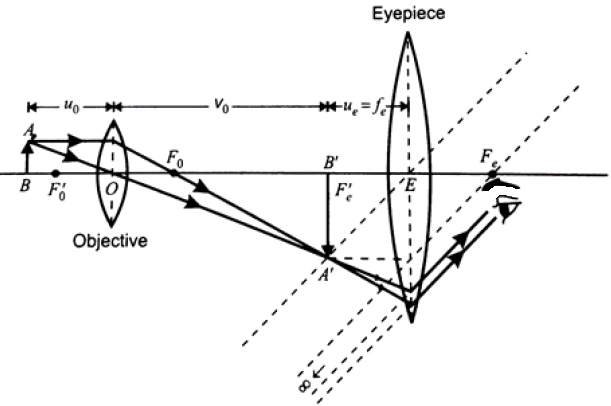
Define the magnifying power of a compound microscope when the final image is formed at infinity. Why must both the objective and the eyepiece of a compound microscope has short focal lengths? Explain.
Answer


When the final image is formed at infinity.
When the final image is formed at infinity, the angular magnification due to the eyepiece is $\text{m}_e=D/\text{f}_e$
Thus, the total magnification when the image is formed at infinity can be defined as the product of magnification of objective lens and eyepiece. i.e
$m = m_om_e = (L/f_o) (D/f_e)$
From the above the equation, we can see that to achieve a large magnification of a small object, the objective and eyepiece should have small focal lengths.

Need a full question paper?

Generate a complete, print-ready paper with questions like this in minutes — across 16+ boards, with answer keys.

Start Generating Free

Similar questions

What will be the radius of a conducting sphere having electric capacitance of one Farad?
Write the formula of spherical mirror and explain it.
Calculate the energy in fusion reaction:
$^{2}_{1}\text{H} + ^{2}_{1}\text{H}\rightarrow^{3}_{2}\text{H}+ \text{n}, \text{where BE}\text{ of} ^{ 2}_{1}\text{H} = 2.23 \text{MeV} \text{and} \text{of} ^{3}_{2}\text{He} = 7.73 \text{MeV}.$
A cell of emf ‘E’ and internal resistance ‘r’ is connected across a variable resistor ‘R’. Plot a graph showing the variation of terminal potential ‘V’ with resistance R. Predict from the graph the condition under which ‘V’ becomes equal to ‘E’.
The mutual inductance between two coils is 2.5H. If the current in one coil is changed at the rate of 1A/s, what will be the emf induced in the other coil?
A ball is thrown vertically upward with a speed of 20m/s. Draw a graph showing the velocity of the ball as a function of time as it goes up and then comes back.
Discuss the intensity of transmitted light when a polaroid sheet is rotated between two crossed polaroids.
An immersion heater rated $1000W, 220V$ is used to heat $0.01m^3$ of water. Assuming that the power is supplied at $220V$ and $60\%$ of the power supplied is used to heat the water, how long will it take to increase the temperature of the water from $15^\circ C$ to $40^\circ C$?
Why does microwave oven heats up a food item containing water molecules most efficiently?
Two charges 2 µC and –2 µC are placed at points A and B 6 cm apart.
  1. Identify an equipotential surface of the system.
  2. What is the direction of the electric field at every point on this surface?