Question
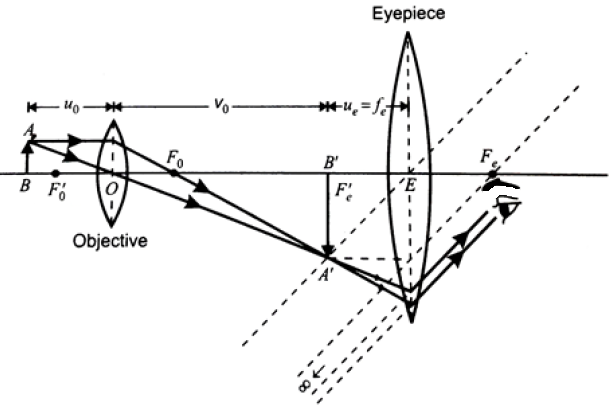
Define the magnifying power of a compound microscope when the final image is formed at infinity. Why must both the objective and the eyepiece of a compound microscope has short focal lengths? Explain.
Answer


When the final image is formed at infinity.
When the final image is formed at infinity, the angular magnification due to the eyepiece is
$\text{m}_e=D/\text{f}_e$
Thus, the total magnification when the image is formed at infinity can be defined as the product of magnification of objective lens and eyepiece. i.e
m = mome = (L/fo) (D/fe)
From the above the equation, we can see that to achieve a large magnification of a small object, the objective and eyepiece should have small focal lengths.

Need a full question paper?

Generate a complete, print-ready paper with questions like this in minutes — across 16+ boards, with answer keys.

Start Generating Free

Similar questions

A water pump lifts water from a level 10m below the ground. Water is pumped at a rate of 30kg/ minute with negligible velocity. Calculate the minimum horsepower the engine should have to do this.
Draw the field lines of Simple electric charge distribution.
What should be the radius ‘r’ of nearest possible orbits of satellite of mass ‘m’ revolving around the planet of mass ‘M’ as per Bohr Postulates in terms of m, M, G, h where G is Gravitational constant and h is plank’s constant.
Derive the equation for the force acting on two parallel current carrying wires.
A bullet travelling with a velocity of 16m/s penetrates a tree trunk and comes to rest in 0.4m. Find the time taken during the retardation.
A metallic sphere is placed in a uniform electric field. Which one of paths a, b, c and d shown in the figure will be followed by the field lines and why?
Find the electric force between two protons separated by a distance of 1 fermi (1 fermi = 10-15m). The protons in a nucleus remain at a separation of this order.
A bulb is made using two filaments. A switch selects whether the filaments are used individually or in parallel. When used with a 15V battery, the bulb can be operated at 5W, 10W or 15W. What should be the resistances of the filaments?
Draw a labelled diagram of an astronomical telescope.
Derive the formula for the magnetic fieid produced by a current-carrying circular coil as a magnetic dipole on its axis and equator. (Perpendicular bisector.)