Question
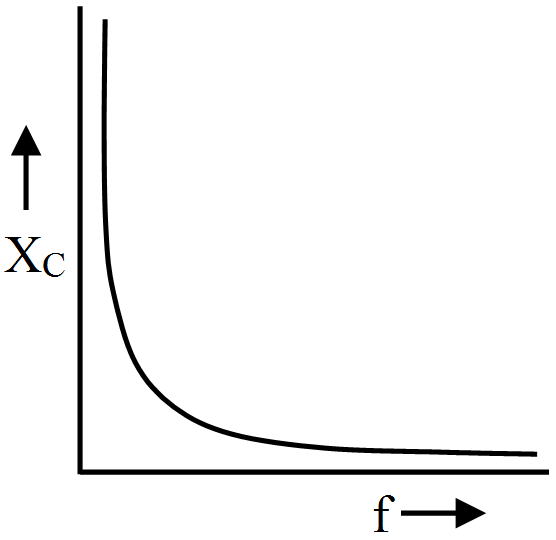
Define the term capacitive reactance. Show graphically the variation of capacitive reactance with frequency of applied alternating voltage.

An ac voltage $\text{V = V}_0\sin\omega\text{t}$ is applied across a pure capacitor of capacitance C. Find an expression for current flowing through it. Show mathematically the current flowing through it leads the applied voltage by angle $\frac{\pi}{2}.$

Answer

Capacitive Reactance: The opposition offered by a capacitor alone to the flow of alternating current through it is called the capacitive reactance.

It is denoted by XC Its value is $\text{X}_{\text{C}}=\frac{1}{\omega\text{C}}=\frac{1}{2\pi\text{fC}}$

The graph of variation of capacitive reactance with frequency is shown in figure.

Phase Difference between Current and Applied voltage in Purely Capacitive Circuit:
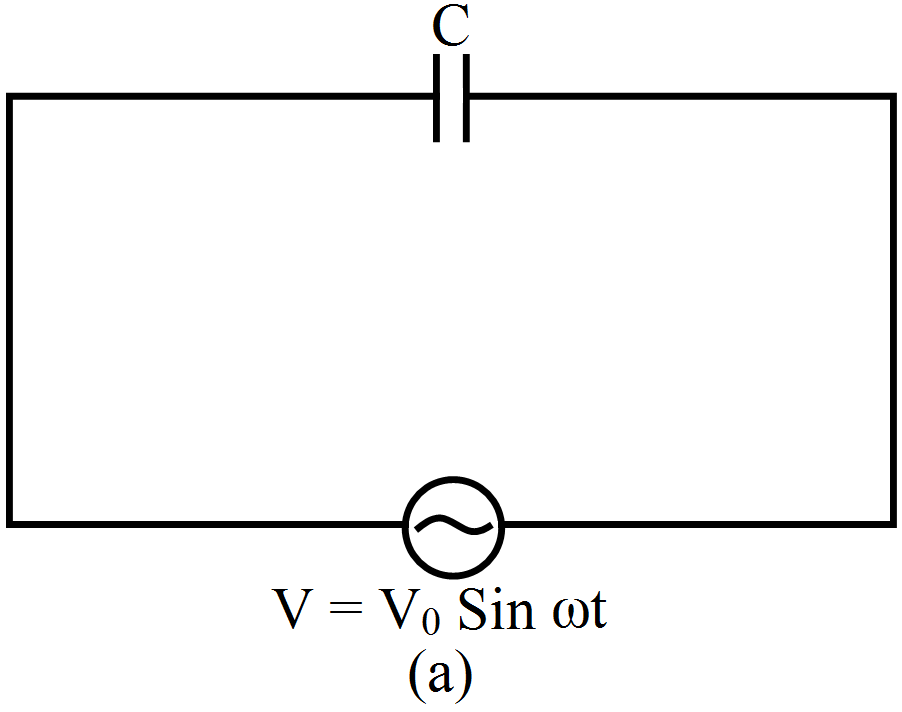
Circuit Containing Pure Capacitance: Consider a capacitor of capacitance C; connected to an alternating voltage source as shown.

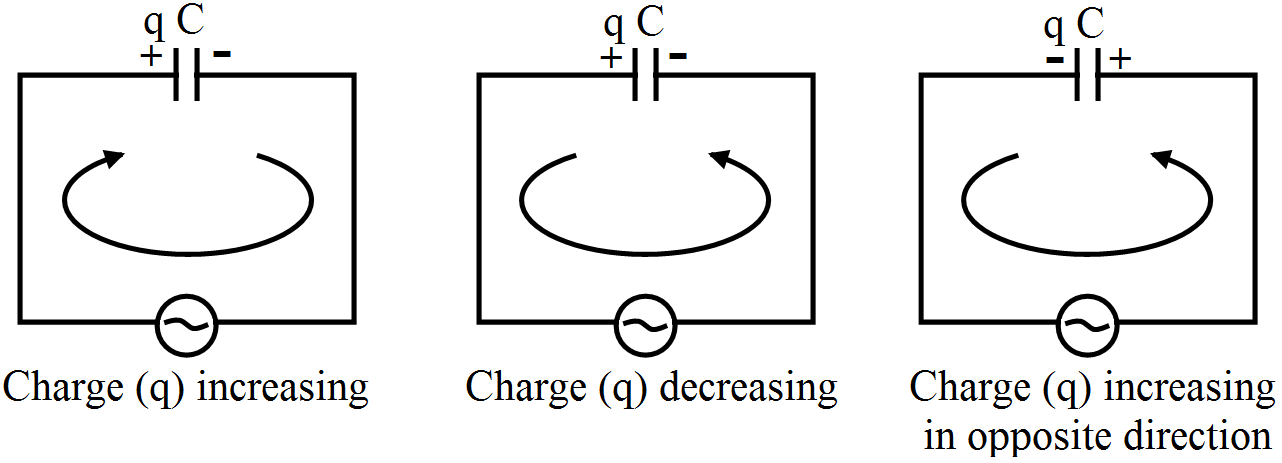
As ac voltage changes in magnitude and direction periodically with a definite frequency; therefore the plates of capacitor get charged, discharged and charged in opposite direction, discharged continuously (Fig. b). Therefore the flow of alternating current in the circuit is maintained. The instantaneous voltage,

$\text{V = V}_0\sin\omega\text{t} \ ...(\text{i})$

Let q be the charge on capacitor and i, the current in the circuit at any instant, then instantaneous potential difference,

$\text{V}=\frac{\text{q}}{\text{c}} \ ...(\text{ii})$

$\text{q}=\text{CV}_0\sin\omega\text{t}$
The instantaneous current,

$\text{i}=\frac{\text{dq}}{\text{dt}}=\frac{\text{d}}{\text{dt}}(\text{CV}_{\text{0}}\sin\omega\text{t})=\text{CV}_{0}\frac{\text{d}}{\text{dt}}(\sin\omega\text{t})$

$=\text{CV}_{0}\omega\cos\omega\text{t}$

$\text{i}=\frac{\text{V}_0}{\Big(\frac{1}{\omega\text{C}}\Big)}\cos\omega\text{t}=\frac{\text{V}_0}{\frac{1}{\omega\text{C}}}\sin\Big(\omega\text{t}+\frac{\pi}{2}\Big)$

$\text{i}=\text{I}_0\sin\Big(\omega\text{t}+\frac{\pi}{2}\Big) \ ...(\text{iii})$

where $\text{i}_0=\frac{\text{V}_0}{\Big(\frac{1}{\omega\text{C}}\Big)}$ = Peak value of A.C. ...(iv)

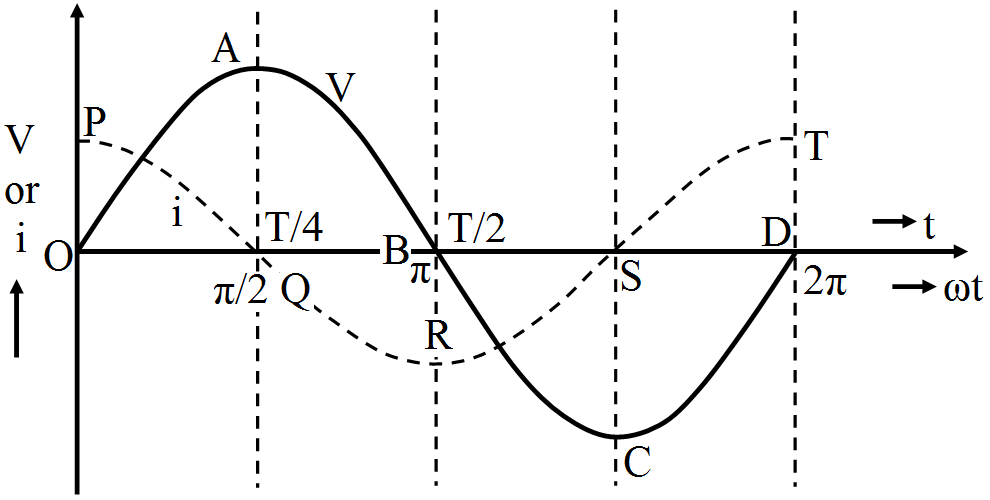
Also comparing (i) and (iii), we note that the current leads the applied emf by an angle $\frac{\pi}{2}$ This is shown graphically in fig. (c).
Need a full question paper?

Generate a complete, print-ready paper with questions like this in minutes — across 16+ boards, with answer keys.

Start Generating Free

Similar questions

A body of mass m makes an elastic collision with another identical body at rest. Show that if the collision is not head-on, the bodies go at right angle to each other after the collision.
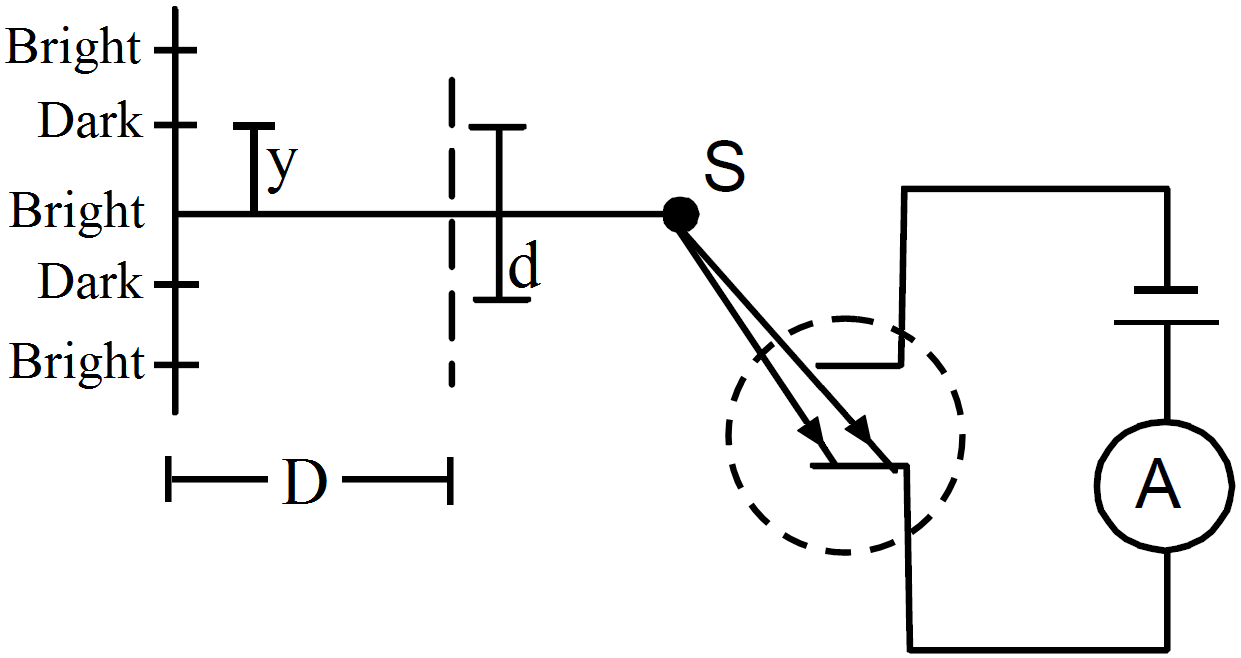
In the arrangement shown in figure y = 1.0mm. d = 0.24mm end D = 1.2m. The work function of the materiel of the emitter is 2.2eV. Find the stopping potential V needed to stop the photocurrent.

A vessel of volume 125cm3 contains tritium $\big(\text{ }^3\text{H,t}_{\frac{1}{2}}=12.3\text{y}\big)$ at 500 kPa and 300K. Calculate the activity of the gas.
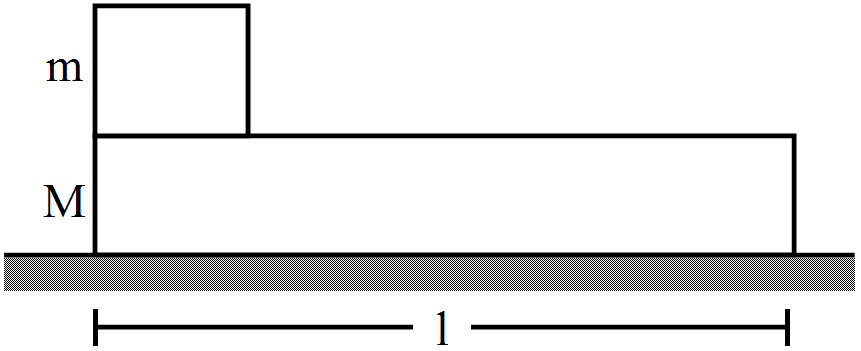
Figure shows a small block of mass m kept at the left end of a larger block of mass M and length l. The system can slide on a horizontal road. The system is started towards right with an initial velocity v. The friction coefficient between the road and the bigger block is g and that between the block is $\frac{\mu}{2}.$ Find the time elapsed before the smaller blocks separates from the bigger block.

A parallel-plate capacitor has plate area 25.0cm2 and a separation of 2.00mm between the plates. The capacitor is connected to a battery of 12.0V:
  1. Find the charge on the capacitor.
  2. The plate separation is decreased to 1.00mm. Find the extra charge given by the battery to the positive plate.
Consider a neutron and an electron bound to each other due to gravitational force. Assuming Bohr's quantization rule for angular momentum to be valid in this case, derive an expression for the energy of the neutron-electron system.
  1. For a ray of light travelling from a denser medium of refractive index n1 to a rarer medium of refractive index nprove that  $\frac{\text{n}_{2}}{\text{n}_{1}} = \sin \text{i}_{c} ,$ where ic is the critical angle of incidence for the media.
  2. Explain with the help of a diagram, how the above principle is used for transmission of video signals using optical fibres.

A solid wire of radius 10cm carries a current 5.0A distributed uniformly over its cross-section. Find the magnetic field B at a point at a distance (a) 2cm (b) 10cm and (c) 20cm away from the axis. Sketch a graph of B versus x for 0 < x < 20cm.
A uniform metre stick of mass 200g is suspended from the ceiling through two vertical strings of equal lengths fixed at the ends. A small object of mass 20g is placed on the stick at a distance of 70cm from the left end. Find the tensions in the two strings.
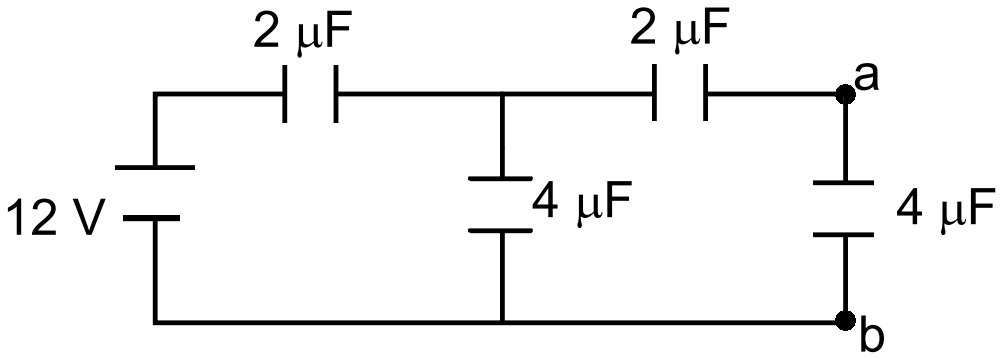
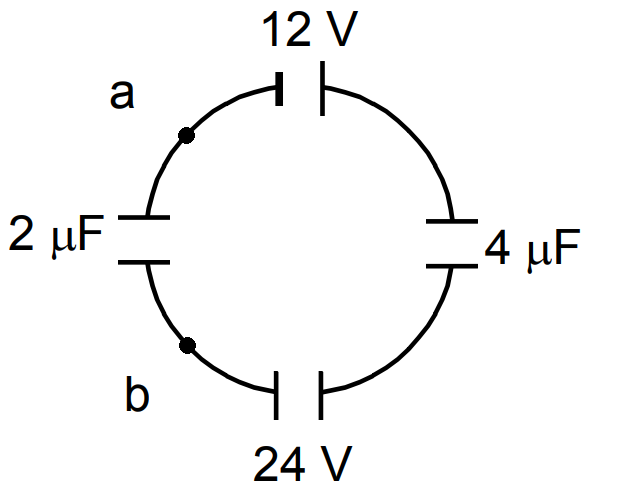
Find the potential difference Va - Vb between the points a and b shown in each part of the figure.